Archive for Egypt – Page 8

Escape to the Sun (Luxor)

Eight Day Tour
Boarding in Luxor
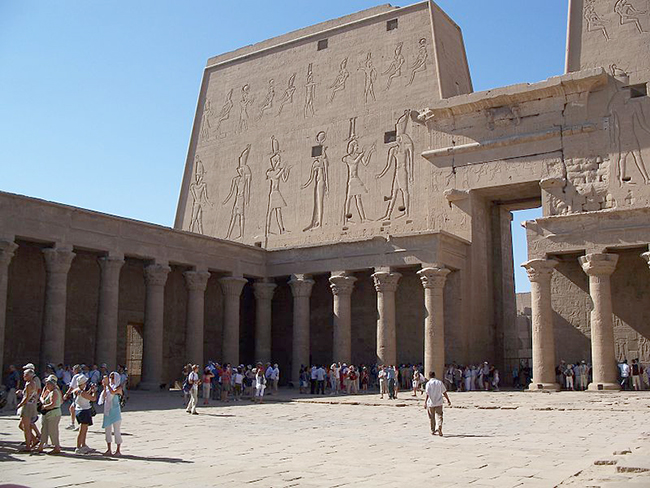
Inside the Temple of Edfu

Inside the Temple of Edfu

Our special 8-day locally escorted tour shows you the top sights in Cairo with four days (three nights) cruising on the Nile, including domestic air fare in Egypt. Add Abu Simbel.

Tour

DAY 1 – CAIRO
Our local representative will meet you at the airport and escort you to your hotel.

VIP Meet & Greet At Cairo Airport
Visa issued locally in Cairo (for a limited number of nationalities) no photos required. Our representative greets you at the airport and whisks you to your hotel. Visa will be issued upon arrival at Cairo Airport for a limited number of citizens such as: American, Australian, NZ, EU, Canadian, EU Singaporean and Japanese citizens. You are responsible for having your passport in order valid at least for 6 month beyond the date of your arrival in Cairo. Our local rep. will meet you with a sign that carries your name, and will be waiting for you with the prepaid visa stamps to proceed to the passports control to stamp your passports and then you claim your luggage. After you clear the passport and customs formalities and exit the terminal, our local representative will escort you by private vehicle to the hotel. Welcome fruit basket & Egyptian pastry awaits you in your room with our compliments.

DAY 2 – CAIRO (BL)
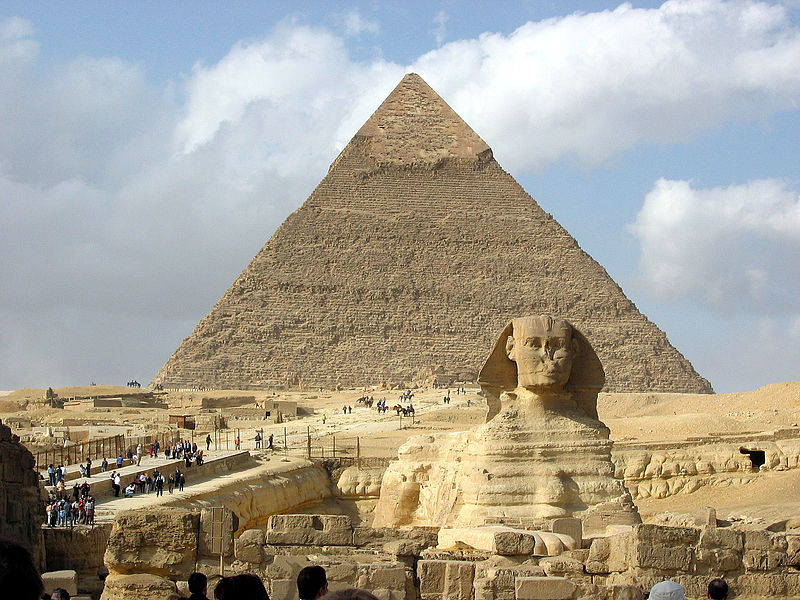
Today we get to know the great Egyptian capital on a full-day tour. We start at the Egyptian Museum, including the Mummy room & Tutankhamoun Gold Treasures, then go on to visit the majestic pyramids of Giza, Cheops own Royal Yacht, the only Royal Barge to survive, this is not to be missed (included in our rate) and the timeless Sphinx, and conclude with the 12th century district of Khan El Khalili.

DAY 3 – LUXOR & ESNA – Board your Nile Cruise (BLD)
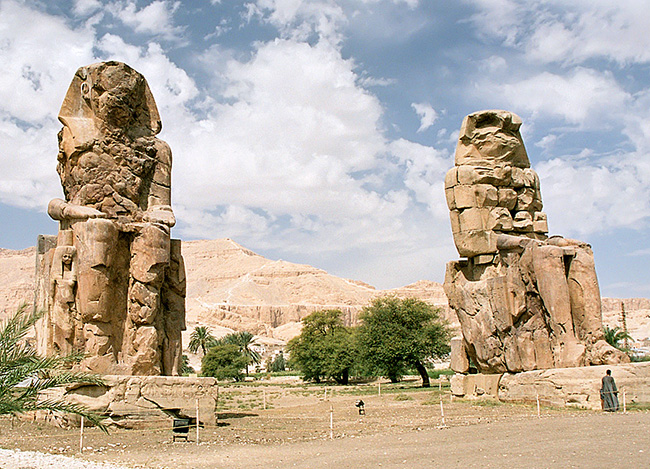
An early flight takes us to Luxor, (Cruise embarkation may also be from Aswan). In Luxor, our local rep will meet you & escort you to your Nile cruise. Welcome fruit basket. After you settle in, we visit the gigantic Temple of Amon at Karnak, the pharaohs’ tombs in the Valley of the Kings, The Ancient Workers Village at Deir El Medineh, and on to the Temple of Queen Hatshepsut at Deir el Bahari, and the Colossi of Memnon. We continue to Esna, where we enjoy a shipboard dinner. Welcome complimentary fruit basket.

DAY 4 – EDFU & KOM OMBO – Cruising the Nile (BLD)
At dockside, we board horse-drawn carriages for the short clip-clop ride through the town of Edfu to the stupendous Temple of Horus, the best preserved temple on the Nile. Returning to our ship, we set sail for Kom Ombo and its famous twin temples dedicated to the sun and the crocodile god. Complimentary Galabya, maybe to wear it for tonight’s costume party.

DAY 5 – ASWAN & PHILAE – On Board Your Nile Cruise (BLD)
We explore the Temples of Horus and Sobek at Kom Ombo, haggle with peddlers for souvenirs, then re-board our ship for the voyage south to Aswan. In the afternoon, we take a motor launch to the Temples of Philae, rescued from the rising waters behind the High Dam., rescued from rising waters, dedicated to the Ancient Goddess ISIS:

Two millennia ago the Mediterranean world was enthralled by the mystery of Isis:

“I, Isis, am all that has been, that is or shall be; no mortal man hath ever seen me unveiled.”

Called Aset by the ancient Egyptians, the goddess was a Madonna in the Mediterranean tradition that stretches far, far back to the primitive Mother Goddess from Anatolia, home to some of the oldest human communities on earth.

Isis was the powerful and quick-witted protector of her son Horus, the Sun God. Ancient peoples throughout the Mediterranean regarded Isis and Horus as the perfect Madonna and Child. Another legend says she was
also the mother of the fertility god Min who, judging from the depiction of him on temple walls, needed no help from Viagra!

Isis is portrayed regally, as a queen seated on a throne (which may be the meaning of her name), often holding her son Horus as a baby. Other images show her with broad, magnificent gilded wings able to protect the world. Isis, the great Mother Goddess. Come explore her mystery in timeless Egypt when you Travel in Style!

In the evening, Aswan’s colorful bazaar awaits us. Complimentary Egyptian sweets/pastry tonight.

DAY 6 – Disembarkation from Your Nile Cruise – Cairo (B)
Complimentary short camel ride to a nearby Nubian Village for tea with the locals. Followed by a tour of the Nubian Museum. We return by plane to Cairo and our hotel. Experience Cairo as you like. Now’s a good time to do your souvenir and gift shopping in the city’s fabled bazaars.

DAY 7- MEMPHIS / SAKKARA / DAHSOUR (BLD)
Enjoy American or Buffet breakfast before we explore the great Egyptian capital in this full-day tour of Memphis, the Step Pyramid of Sakkara and DAHSOUR. We’ll motor to the edge of Cairo, to the mysterious Sphinx and the Pyramids of Giza. Those who are fit and adventurous enough may wish to penetrate into the heart of the Great Pyramid, to the King’s Chamber (or the interior of Kephren Pyramid, depending). Continue to Dahshour, the newly-opened pyramid field south of Cairo. We visit the great pyramid of Senfru, father of Cheops, and other structure:

The “Discovery” of Dahshour:
For almost half a century, the great field of huge pyramids near the desert village of Dahshour, 25 miles south of Cairo, has been off limits to the public. Confined within the perimeter of a military base were many pyramids, including the great 4500-year-old pyramid built by Senfru, father of Cheops. Senfru’s pyramid, the largest in Egypt until his son built Giza’s Great Pyramid, is rhomboidal in shape: it tapers more distinctly on its upper half. All the pyramids were coated in thick plaster at one time. Most have lost these protective, decorative sheaths, but Senfru’s — miraculously — is still in place.

Lunch is included at a local restaurant. Dinner is included at La Bodeg Restaurant or Abu El Sid or similar

DAY 8- DEPARTURE (aB)
After breakfast, our staff escorts you to the airport for your flight home. Bon Voyage!

Rates per person in USD
Hotel / Cruise
Deluxe Hotel
Deluxe Nile Cruise
First Class Hotel
First Class Nile Cruise
In Triple Occupancy
US$ 1840.00
US$ 1649.00
In Double Occupancy
US$ 1965.00
US$ 1750.00
In Single Occupancy
US$ 3095.00
US$ 2810.00

Please add a supplement of 20% to these rates for: December 20 to January 3, or during Easter Week

Sample deluxe Nile Cruise:
M/S Monte Carlo, M/S Mojito and the M/S Monaco, Mövenpick M/S Radamis II

Rates include:

  • VIP Meet & Greet At Cairo Airport
    Our representative will greet you at the airport and whisk you to your hotel. Visa will be issued upon arrival at Cairo Airport (photos are not required).
  • Egyptian Visa will be issued for a limited number of citizens such as: American, Australian, NZ, EU, Canadian, EU Singaporean and Japanese citizens. You are responsible for having your passport in order valid at least for 6 month beyond the date of your arrival in Cairo. Our local rep. meets with a sign that carries your name, and will be waiting for you with the prepaid visa stamps to proceed to the passports control to stamp your passports, then you claim your luggage. After you clear the passport and customs formalities and exit the terminal, our local representative will escort you (private vehicle) to the hotel. Welcome fruit basket & Egyptian pastry awaits you in your room in Cairo upon arrival with our compliments.
  • Domestic airfare within Egypt in economy class tax included, tickets issued & delivered in Cairo.
  • All transfers within Egypt, always on a private basis, private air-conditioned vehicle, private chauffeur
  • Bottled water ( one large bottled per person) delivered to your cabin daily while you are on board.
  • Tea or coffee and small bottled water with each & every meal while you are on board the Nile Cruise.
  • Complimentary welcome drink upon arrival on board the Nile Cruise.
  • Complimentary welcome fruit basket in your cabin upon arrival on board the Nile Cruise.
  • Pre set menu meals including B = Breakfast, (or cB, Continental Breakfast) L = Lunch, D = Dinner.
  • Hotel accommodation,including tax & service charges.
  • Guided sightseeing as per itinerary including all entrance fees
  • Nile cruise including all meals & shore excursions. For a private Egyptology while on board the cruise, please add $250 per person, but this doesn’t for the Ultra Deluxe category please click here,, this will include as well private air conditioned car /driver for the duration of the Nile Cruise.

Rates do not include:

  • Any international airfare
  • Travel Insurance
  • Tips

Dining Room Reservations. Meet other passengers:
YOU will not require any, our dining rooms do accommodate all our guests in one seating, one less thing to worry about while you are on the Nile. Enjoy the cosmopolitan atmosphere with several different languages being heard at dinner. Smart Casual dress is suggested for dinner. No tie/Formal dress requirement

Clothing on board:
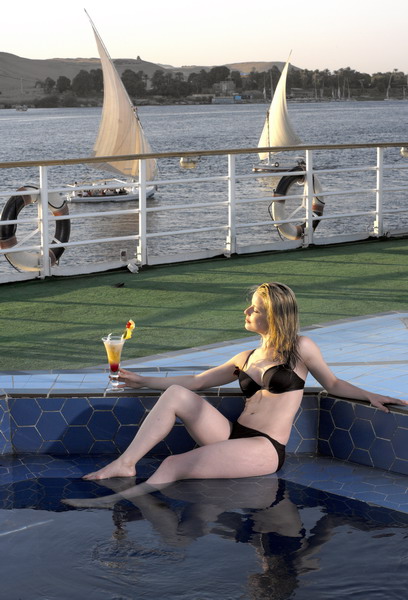
Lightweight comfortable & casual clothing, swimsuits, sun hat. Dinning room dress code: Casual for breakfast & lunch, smart casual for dinner. All ships are fully air conditioned.

DRESS CODE:
All of our Nile cruise vessels are fully air conditioned. Onboard dress is casual except at dinner, when smart casual is the rule. Lightweight cotton and other natural fiber clothing is best, with swimsuits and sun hats for the sundeck and pool. Bring a light sweater or light jacket for cool mornings and evenings, but most days are warm to hot, with very little rain. Comfortable walking shoes are essential for shore excursions.

What to Pack:
Most of the year look forward to warm, even hot weather in Cairo, Luxor & Aswan, morning & evenings are cooler. During Winter… very rare do we get rain, if so, very brief showers. No need for real rain wear/gear. Before sunrise, after sun-set, you’ll need a light jacket, or light sweater. For Nile cruise shore excursions, we suggest comfortable cotton & natural fabric lightweight clothing. Comfortable walking shoes are essential for all tours in Cairo or Upper Egypt.
Egypt in a Week

A Grand 8-Day tour of Egypt

Board your Nile cruise in LUXOR – Abu Simbel Edition
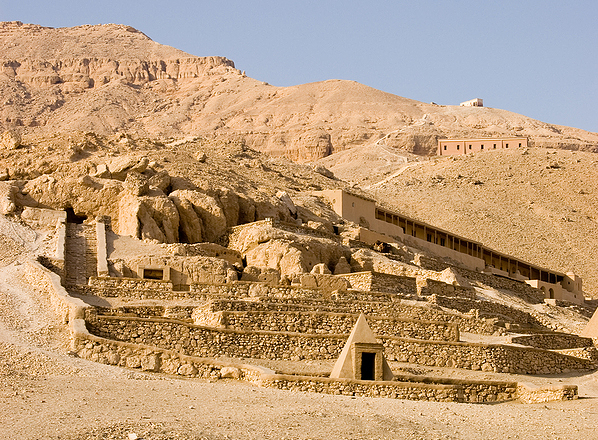
Pyramids and stone walls surrounding the workmen's tombs at Deir el Medina. West Bank of the Nile at Luxor.

Pyramids and stone walls surrounding the workmen’s tombs at Deir el Medina.

Here’s the best of Egypt in a week: a good look at Cairo. Flights to tour the mighty temples of Abu Simbel and a 5-day cruise along the Nile.

Tour

DAY 1 – CAIRO Tour Starts Weekly in Cairo – Thursday – Year Round (For Daily Arrival please click here).
Our local representative will greet you at the airport and whisk you to your hotel. Visa fee is included and will be issued upon arrival at Cairo Airport.

VIP meet & greet at Cairo Airport
Visa issued locally in Cairo (for a limited number of nationalities) no photos required. Our representative greets you at the airport and whisks you to your hotel. Visa will be issued upon arrival at Cairo Airport for a limited number of citizens such as: American, Australian, NZ, EU, Canadian, EU Singaporean and Japanese citizens. You are responsible for having your passport in order valid at least for 6 month beyond the date of your arrival in Cairo. Our local rep. will meet you with a sign that carries your name, and will be waiting for you with the prepaid visa stamps to proceed to the passports control to stamp your passports and then you claim your luggage. After you clear the passport and customs formalities and exit the terminal, our local representative will escort you by private vehicle to the hotel. Welcome fruit basket & Egyptian pastry awaits you in your room with our compliments.

DAY 2 – CAIRO – Friday (BLD)
Private touring: private air-conditioned vehicle, private chauffeur, private guide. On your first full day in Egypt we show you the Egyptian Museum, including the “Mummies Room”, and King Tut’s gold treasure room, then drive to the edge of Cairo and Giza desert to stand in awe in front of the Pyramids of Giza, the Sphinx. Lunch is included at the Mena House. Dinner is included at La Bodega restaurant.

DAY 3 – LUXOR! (or Aswan) – Saturday (BLD)
We fly to LUXOR (or Aswan) and board your Nile cruiser in time for a delicious lunch. Complimentary welcome fruit basket awaits you in your cabin.The gigantic Great Temple of Amon at Karnak, and the mighty Temple of Luxor are our goals in the afternoon. We’ll return in time for the afternoon tea served on deck. You’ll have a chance to explore your ship before dinner. Evening Karnak Sound and Light show, please bring a jacket and a flash light.

Video by denniscallan

DAY 4 – LUXOR, EDFU- Sunday (BLD)
We tour today as well the magnificent tombs in the Valley of the Kings including Tut-Ank-Amon’s tomb and the great temple of Queen Hatshepsut, we stop at the Colossi of Memnon on the way back to our cruise.

Afterward, we’ll continue on Luxor’s west bank to get a totally different perspective on ancient Egyptian life, at the ancient workers’ settlement of Deir el-Medinah. While most of the imposing stone monuments and sites of Egypt honor the lives and after-lives of royalty, Deir el-Medinah gives us unique and surprising insights into the ordinary citizens who constructed and decorated the tombs. Here we’ll see the excavated homes shared by laborers with their domestic animals. These quarters were surprisingly large, with three good-sized rooms, courtyard, kitchen, and even storage cellars. While ancient Egypt might not have been a workers’ paradise, we’ll see that artisans and builders were highly regarded in their community. We are proud to be the only operator to offer regular visits to this singular ancient settlement in its tour and cruise programs.

We sail in the afternoon cruising to Esna to go through the locks, and on to Edfu where we dock for the night. In the evening, we’ll celebrate in Egyptian style, dressed in galabias, the flowing national costume (a galabya will be delivered to your cabin with our compliments).

DAY 5 – EDFU, KOM OMBO – on board your Nile Cruise – Monday (BLD)
We moor in Edfu, climb aboard horse-drawn carriages, and clip-clop through the town to the Temple of Horus, Egypt’s best-preserved temple. Re-embarking on our Nile cruiser, we enjoy lunch as we sail further south upriver. We disembark downstream at Kom Ombo to visit its twin temples of Haroeris, the sun god, and Sobek, the crocodile god, the continue our voyage to Aswan, while we party after dinner with music and dance.

DAY 6 – CAMEL CARAVAN, NUBIAN VILLAGE, ASWAN – on board your Nile Cruise- Tuesday (BLD)
Today we tour Aswan dams. First we will go to the new Nubian Museum then on to the awesome Aswan dams. Next we will explore an ancient granite quarry complete with an unfinished obelisk. Then we go by motor launch to the Island temple of Philae, dedicated to the Ancient Goddess ISIS:

The Mystery of Isis

Two millennia ago the Mediterranean world was enthralled by the mystery of Isis: “I, Isis, am all that has been, that is or shall be; no mortal man hath ever seen me unveiled.”

Called Aset by the ancient Egyptians, the goddess was a Madonna in the Mediterranean tradition that stretches far, far back to the primitive Mother Goddess from Anatolia, home to some of the oldest human communities on earth.

Isis was the powerful and quick-witted protector of her son Horus, the Sun God. Ancient peoples throughout the Mediterranean regarded Isis and Horus as the perfect Madonna and Child. Another legend says she was also the mother of the fertility god Min who, judging from the depiction of him on temple walls, needed no help from Viagra!

Because of her wisdom and skill at protection, she was admired as a good magician capable of healing the sick and protecting the dead in their journey to the Underworld.

Isis is portrayed regally, as a queen seated on a throne (which may be the meaning of her name), often holding her son Horus as a baby. Other images show her with broad, magnificent gilded wings able to protect.

In the afternoon we enjoy a leisurely sail by graceful felucca on the Nile.

For those who are interested: a short camel caravan and ride is included (almost a half hour ride) to visit a local Nubian Village. Our farewell dinner this evening is a buffet of Egyptian specialties, followed by a show featuring oriental performers, including of course a belly dancer.

In the evening your guide will call on you for a horse-drawn carriage ride throughout Aswan and waterfront.

DAY 7 – ASWAN, Private touring in Abu Simbel – CAIRO – Wednesday (B. Lunch box.D)
Breakfast is always included daily. Today your chef will prepare your lunch box, including bottle water. Board a short flight to Abu Simbel: where your private air-conditioned vehicle, private guide and private chauffeur await you:

Ramses the Great’s huge desert temple at Abu Simbel marked the southern border of the pharaoh’s dominions. Rescued from the rising waters of Lake Nasser by an international effort, it is a marvel of sacred engineering. Twice a year,and only then the sun penetrates to the Holy of Holies, illuminating the stone figures of Ramses and Nefertari. Group tour exploring the two huge temple, admire their ancient aura and artistry.

Fly back to Aswan and connect with your our return flight to Cairo and your hotel. Dinner is included at your hotel in cairo

DAY 8 – CAIRO – Departure – Thursday (B)
Our representative escorts you to the airport for your homeward flight. Bon Voyage. Transfers are always on a private basis.

Rates per person in USD
Deluxe
First Class
Tourist Class
Triple Occupancy
US$ 2275.00
US$ 1980.00
US$ 1771.00
Double
US$ 2350.00
US$ 2050.00
US$ 1882.00
Single
US$ 3287.00
US$ 2941.00
US$ 2489.00
Sample Nile Cruises
or similar
M/S Monaco
M/S Mojito
M/S Monte Carlo
M/S Lady Diana
M/S Nile Dream
M/S Ruby
M/S Nile Dream
M/S Ruby
Sample Cairo Hotels
or similar
Hilton. Sheraton
Meridien. Sonesta
Oases. Shepheard’s
Novotel
  • Children Discount: 9 years of age and younger, sharing with parents same room: 40 %.
  • For Dec 15 – Jan 3 and Easter, please add 10% supplement to any of the listed rates.
  • Private touring on board the cruise: Please add $ 250 per person for the full cruise/shore excursions.

Rates includes:

  • All domestic airfares, in economy class within Egypt, tax included.
  • All transfers in Egypt, always on a private basis, private air-conditioned vehicle, private chauffeur.
  • Bottled water (one per person) delivered to your cabin daily while you are on board the cruise.
  • Tea or coffee/bottled water with each meal while on board the cruise.
  • Hotel accommodation with tax & service charges.
  • Nile Cruise with all meals and shore excursions.
  • Complimentary welcome fruit basket awaits you in your cabin.
  • Complimentary galabya on board the cruise for the costume party.
  • Preset menu meals including B = Breakfast, (or cB, Continental Breakfast) L = Lunch, D = Dinner.
  • All guided sightseeing as per itinerary including all entrance fees. Private Egyptologist while in Cairo, but while on board the cruise you’ll be part of an average 10-15 English speaking group.
  • VIP Meet & Greet Service Upon Arrival At Cairo Airport
    Visa issued locally in Cairo (for a limited number of nationalities) no photos required. Our representative greets you at the airport and whisks you to your hotel. Visa will be issued upon arrival at Cairo Airport for a limited number of citizens such as: American, Australian, NZ, EU, Canadian, EU Singaporean and Japanese citizens. You are responsible for having your passport in order valid at least for 6 month beyond the date of your arrival in Cairo. Our local rep. will meet you with a sign that carries your name, and will be waiting for you with the prepaid visa stamps to proceed to the passports control to stamp your passports and then you claim your luggage. After you clear the passport and customs formalities and exit the terminal, our local representative will escort you by private vehicle to the hotel. Welcome fruit basket & Egyptian pastry awaits you in your room with our compliments.

Not included:

  • International airfares to or from Cairo
  • Tips
  • Travel Insurance
Boutique Style Hotels in Egypt – Available Upon Request

Cairo: Le Riad in the heart of El Moezz street in Cairo
In the heart of islamic medieval Cairo, a place acknowledged worldwide as the patrimony of humanity, Le Riad is the only one Hôtel de Charme 5 minutes walking distance from the famous souk of Khan El Khalili. Only 17 very private suites facing El Darb El Asfar and its exceptionnal ottoman houses. On the roof garden you will discover the 1000 minarets of Cairo and enjoy a panoramic view: the Fatimid walls, the Moquattam’s hills, the citadel of Mohamed Ali. And at your feet: mosques, sabils, madrasas, khanqas, khans mainly from mamluk time. The Riad will introduce you in an oriental dream with its typical old egyptian architecture, domes, arches, moucharabiehs, warm colors and its refined decoration mixing antiques with an amazing collection of drawings, paintings and silver jewellery. A 30 minutes drive from Cairo International Airport, the Riad is easily reachable by car.

Anakto Nubian House – Aswan
Nesting on a ridge, AnaKato possesses an extraordinary view of the Nile all the way from Aswan to the Aswan Reservoir. A placid, tranquil environment, and the generous hospitality of the natives is so calming, its hard to imagine how one could return to the bustle of civilization.

Built as a traditional Nubian house, its unique and bright colours impose the feeling of peaceful happiness. Knowing that whomever has come to AnaKato, searching for inner peace, has reached their purpose, we welcome you into our haven, far away from any soul pollution.

The rooms are simply but tastefully furnished in the local style. With only 5 rooms the house is quaint yet cozy and familiar. Also on location is a mini-mart. The staff is friendly, love their job, and will be happy to help with any of your questions.

The legendary Tree that grows beneath the house shades a spectacular terrace, at the very edge of the cool Nile waters. We also provide a morning coffee shop and a bazaar that sells hand-made goods. Anything you will buy will help the people of the village, so you will be contibuting to the community. You can relax on the little strip of sandy beach and cool off with a refreshing dip in the Nile.

There is also traditional Nubian music, dancing. And if you are in luck, and there is a wedding in the village, you may surely want to join the party, an event not to be missed! Camel rides are also available to take you to the unique, red sandy “Barbar beach.” Or if you prefer to go out into the desert for a safari we cater for that too. Also available on demand are henna tattooing and medicinal sand-burying.

The King’s Chamber in the Great Pyramid was not meant to be visited:
Getting to it is challenging, and once you enter, it is very difficult to turn back. The stone passage is only wide enough for one person. You must be in good physical condition, able to climb several flights of stairs, bend double, crouch and duck-walk for short distances. The King’s Chamber itself is the world’s most claustrophobic place, with dim light and heavy, hot, oxygen-poor air. There is no ventilation. If you are at all sensitive to claustrophobia or confinement, or if you have any sort of respiratory condition, for your own safety and the safety of others, you must not enter the pyramid because it is impossible to remove a person or to bring aid to them quickly.

Egypt in a Week

Boarding Aswan – Foray Into Nubia: Abu Simbel

Pool on the MHR Radamis

Here’s the best of Egypt in a week: a good look at Cairo and a 5-day cruise along the Nile, locally escorted. Choose your own date – Tour starts DAILY in Cairo – Year Round. Click here to add a tour of Queen Nefertiti’s Capital: El Minya & Tel Al-Amarna.

Tour

DAY 1 – CAIRO Tour Starts DAILY in Cairo – Arrive any day of the week
Our local representative will greet you at the airport and whisk you to your hotel. Visa fee is included and will be issued upon arrival at Cairo Airport.

VIP Meet & Greet Upon arrival at Cairo Airport?
Visa issued locally in Cairo (for a limited number of nationalities) no photos required. Our representative greets you at the airport and whisks you to your hotel. Visa will be issued upon arrival at Cairo Airport for a limited number of citizens such as: American, Australian, NZ, EU, Canadian, EU Singaporean and Japanese citizens. You are responsible for having your passport in order valid at least for 6 month beyond the date of your arrival in Cairo. Our local rep. will meet you with a sign that carries your name, and will be waiting for you with the prepaid visa stamps to proceed to the passports control to stamp your passports and then you claim your luggage. After you clear the passport and customs formalities and exit the terminal, our local representative will escort you by private vehicle to the hotel. Welcome fruit basket & Egyptian pastry awaits you in your room with our compliments.

DAY 2 – CAIRO (BL)
On your first full day in Egypt we show you the Egyptian Museum, including the ” Mummies Room” and King Tut’s gold treasure room, the Pyramids of Giza, the Sphinx, the Citadel of Saladin, and the Mohammed Ali Mosque, made of alabaster. Lunch is included at the Mena House.

DAY 3 – ASWAN, ABU SIMBEL – Ramses the Great – Master Builder of All Times. Camel Caravan! (BLD)
We fly to Aswan (or Luxor) and connect to Abu Simbel, where your private guide, private air-conditioned vehicle and private chauffeur will be waiting for you.

Ramses the Great’s huge desert temple at Abu Simbel marked the southern border of the pharaoh’s dominions. Rescued from the rising waters of Lake Nasser by an international effort, it is a marvel of sacred engineering. Twice a year, and only then the sun penetrates to the Holy of Holies, illuminating the stone figures of Ramses and Nefertari. Group tour exploring the two huge temple, admire their ancient aura and artistry.

Fly back to Aswan and board our Nile cruiser in time for a delicious lunch. Complimentary welcome fruit basket awaits you in your cabin. In the afternoon we enjoy a leisurely sail by graceful felucca on the Nile. Only for those who are interested: a short camel caravan to visit a local Nubian Village. Private touring in Abu Simbel, Aswan and even for your cruise shore excursions.

DAY 4 – ASWAN – KOM OMBO – On Board Your Nile Cruise (BLD)
First we tour new Nubian Museum then the awesome Aswan dams, and next an ancient granite quarry complete with an unfinished obelisk. Then we go by motor launch to the Island temple of Philae, dedicated to the Ancient Goddess ISIS: Called Aset by the ancient Egyptians, the goddess was a Madonna in the Mediterranean tradition that stretches far, far back to the primitive Mother Goddess from Anatolia, home to some of the oldest human communities on earth.

Isis was the powerful and quick-witted protector of her son Horus, the Sun God. Ancient peoples throughout the Mediterranean regarded Isis and Horus as the perfect Madonna and Child. Another legend says she was also the mother of the fertility god Min who, judging from the depiction of him on temple walls, needed no help from Viagra!

Because of her wisdom and skill at protection, she was admired as a good magician capable of healing the sick and protecting the dead in their journey to the Underworld.

Isis is portrayed regally, as a queen seated on a throne (which may be the meaning of her name), often holding her son Horus as a baby. Other images show her with broad, magnificent gilded wings able to protect the world. Isis, the great Mother Goddess. Come explore her mystery in timeless Egypt when you Travel in Style!
Re-embarking on our Nile cruiser, we sail downstream to Kom Ombo to visit its twin temples. Private touring for your cruise shore excursions.

DAY 5 – EDFU – on Board Your Nile Cruise (BLD)
We moor in Edfu, climb aboard horse-drawn carriages, and clip-clop through the town to the Temple of Horus, Egypt’s best-preserved temple. Re-embarking. Evening finds us in Luxor. In the evening your guide will call on your for a horse drawn carriage ride throughout Luxor souks and water front. Private Egyptologist for all the Nile cruise shore excursions.

DAY 6 – LUXOR – On Board Your Nile Cruise (BLD)
We tour today as well the magnificent tombs in the Valley of the Kings, including Tutankaomn’s tomb, and the great temple of Queen Hatshepsut, we stop at the Colossi of Memnon on the way back to our cruise.

Afterward, we’ll continue on Luxor’s west bank to get a totally different perspective on ancient Egyptian life, at the ancient workers’ settlement of Deir el-Medinah. While most of the imposing stone monuments and sites of Egypt honor the lives and after-lives of royalty, Deir el-Medinah gives us unique and surprising insights into the ordinary citizens who constructed and decorated the tombs.

Here we’ll see the excavated homes shared by laborers with their domestic animals. These quarters were surprisingly large, with three good-sized rooms, courtyard, kitchen, and even storage cellars. While ancient Egypt might not have been a workers’ paradise, we’ll see that artisans and builders were highly regarded in their community. We are proud to be the only operator to offer regular visits to this singular ancient settlement in its tour and cruise programs. Evening Sound and Light Karnak Show, please bring a jacket and a flash light.

DAY 7 – LUXOR – CAIRO – Home Hosted Family Dinner (B)
The gigantic Great Temple of Amon at Karnak, and the mighty Temple of Luxor are our goals in the morning, followed by a return flight to Cairo. In the afternoon, wander through the city on your own, or do your last-minute shopping.

Complimentary Dinner is included at a local home:
Meet the locals. You may wish to bring token gifts to exchange with the host family (T shirt, small souvenirs of your home town). This evening we’ll venture where few ordinary visitors ever tread… right into the homes of some of the people of Cairo! You’ll be invited to a family dinner, and while you enjoy wholesome home-cooked specialties, you’ll learn about and appreciate the outlook, aspirations, and way of life of your hosts. Be assured, as curious as you may be about your new friends, they’re sure to have questions about your own background. Once the ice is broken, you’ll enjoy a lively evening and find that you have more in common than you ever suspected. Of course, if you prefer, you may enjoy a quiet evening with your travel companions, by letting us know your preferences.

DAY 8 – CAIRO- Departure (B)
Our representative escorts you to the airport for your homeward flight.

Rates per person in USD:
Deluxe
A
Deluxe
B
First Class
Triple Occupancy
US$ 2325.00
US$ 2105.00
US$ 1910.00
Double
US$ 2485.00
US$ 2275.00
US$ 2045.00
Single
US$ 3499.00
US$ 3180.00
US$ 2920.00
  • For Dec 15 – Jan 3 and Easter, please add 10% supplement to any of the listed rates.

Rates includes:

  • All domestic airfares with tax and transfers within Egypt.
  • Hotel accommodation with tax & service charges.
  • A complimentary home hosted family dinner in Cairo.
  • Bottled water (one per person) delivered to your cabin daily while you are on board the cruise.
  • Tea or coffee/bottled water with each meal while on board the cruise.
  • Nile Cruise with all meals, one large bottle water (per person) daily while on board the cruise & a welcome fruit basket
  • All the shore excursions while on board the Nile Cruise and a complimentary welcome drink.
  • Preset menu meals including B = Breakfast, (or cB, Continental Breakfast) L = Lunch, D = Dinner.
  • All guided sightseeing as per itinerary including all entrance fees. On board the cruise you’ll be part of an average 10-15 English speaking group.
  • VIP Meet & Greet Service Upon Arrival At Cairo Airport
    Visa issued locally in Cairo (for a limited number of nationalities) no photos required. Our representative greets you at the airport and whisks you to your hotel. Visa will be issued upon arrival at Cairo Airport for a limited number of citizens such as: American, Australian, NZ, EU, Canadian, EU Singaporean and Japanese citizens. You are responsible for having your passport in order valid at least for 6 month beyond the date of your arrival in Cairo. Our local rep. will meet you with a sign that carries your name, and will be waiting for you with the prepaid visa stamps to proceed to the passports control to stamp your passports and then you claim your luggage. After you clear the passport and customs formalities and exit the terminal, our local representative will escort you by private vehicle to the hotel. Welcome fruit basket & Egyptian pastry awaits you in your room with our compliments.

Not included:

  • International airfares to or from Cairo
  • Tips
  • Travel Insurance
Sample Hotel & Cruise listing

Deluxe – A
Cairo Hotels: Conrad / Hyatt / Cairo Marriott or similar.
Nile Cruise: M/S Monaco, M/S Mojito, M/S Queen of Hansa or similar

Deluxe – B
Cairo Hotels: Hilton, Sheraton or similar
Nile Cruise: M/S Lady Diana, M/S Florence, MS Princess Sara, or similar

First Class
Cairo Hotels: Oases or similar
Nile Cruise: M/S Nile Dream, M/S Ruby, or similar

Cleopatra, Antony and Caesar

The Greatest Love Story of all Time
Join the Tour

Cleopatra

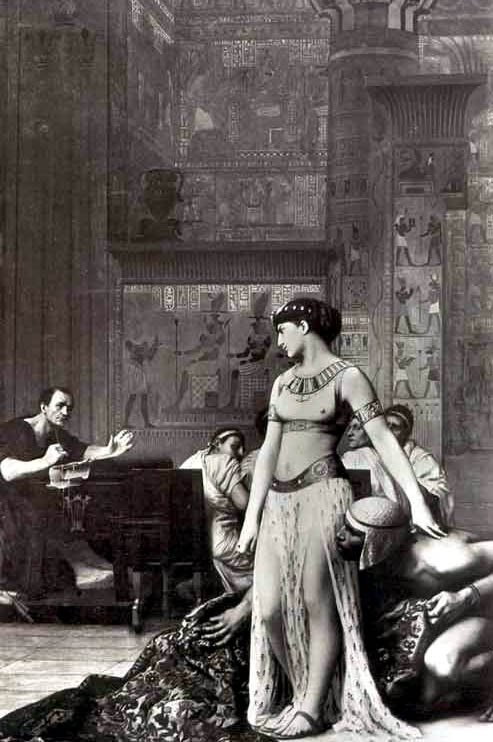
Hollywood’s portrayal of Cleopatra, Queen of the Nile, differs from the historical record, of course. Yet the real Cleopatra was even more fascinating than in the movies.

Born in Alexandria in 69 BC, she may not have been particularly beautiful. Her portrait on coins of the time shows her with a hooked nose and manly features, though her voice was said to be alluring, and she was obviously of high intelligence and ability. She was not actually of Egyptian blood, but of Macedonian, descended from one of Alexander the Great¹s generals who had come to Egypt in the 300s BC and established himself as King Ptolomy I.

She came to the throne as Cleopatra VII in 51 BC, at the age of 17 or 18. Exiled three years later in a palace coup, she regained her throne with Julius Caesar¹s help. He called for her to appear before him, but knowing that plotters would kill her on the way, she had herself rolled up in an oriental carpet and carried into the palace secretly. Servants unrolled the carpet before Caesar, and Cleopatra fell out at his feet.

The Roman general was captivated by the vivacious, independent-minded young queen with the beautiful voice and fiery eyes. Caesar restored Cleopatra to her throne and they embarked on a two-month-long cruise up the Nile. Their son Caesarion was born shortly thereafter.

Cleopatra visited Rome in 46 BC, was received in triumph, and moved into Caesar’s villa even though Caesar was already married. Caesar’s imperial ambitions and his indiscreet extramarital affair with Cleopatra turned powerful senators against him, and he was murdered on the steps of the Senate in March of 44 BC.

CleopatraCleopatra fled to Egypt, but was called to Tarsus (on present-day Turkey’s southern coast) by Mark Antony, one of the new rulers of Rome, to account for her actions. She arrived, dressed as Venus, goddess of Love, aboard a sumptuous “barge” sailed by a crew of female servants dressed as sea nymphs. The ship had a gilded stern, silver-tipped oars, and purple sails. Antony was bewitched! He told her dirty jokes and she told better ones right back. Whatever he wanted to do, she would do with him, proving herself his equal. When she returned to Egypt, Antony went with her to spend the winter in Egypt’s pleasant climate rather than rainy Rome.

Not long after Antony returned to Rome, Cleopatra gave birth to twins. In Rome Antony married his co-emperor Octavian’s sister and started a family, but four years later he was back in Alexandria, unable to live without Cleopatra. He married her in 36 BC, and never went back to Rome. Rome had had enough! Octavian invaded Alexandria in 30 BC.

On the verge of battle, Antony’s fleet went over to the Roman side, and soon also did his cavalry. Antony fled to Alexandria and, thinking Cleopatra dead, stabbed himself. On learning she was still alive he had himself carried to her, and died in her arms. Octavian captured the Egyptian queen and set guards on her to make sure she did not commit suicide. He wanted to parade her through Rome triumphantly in chains. But she arranged for a servant to smuggle in an asp (a poisonous snake) in a basket of figs. She ate the figs, and wrote Octavian a letter asking that she be buried with Antony.

Alexander the Great's tomb

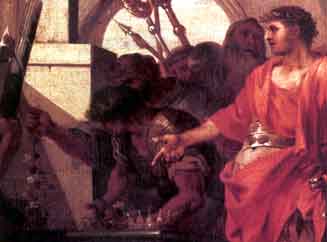
Octavious visiting Alexander the Great’s Tomb in Alexandria. Octavious had just defeated Cleopatra and Marc Anthony armies. He left his coat at Alexander the Great’s tomb as a token of respect. The search continues for Alexander the Great’s Tomb.

Octavian, sensing what this meant, alerted her guards to an attempt at suicide, but it was too late. Queen Cleopatra VII was dead at the age of 39. She was buried with Antony, leaving behind her a love story the world will never forget.

More About Cleopatra

For more publications about the history of Cleopatra visit  www.royalty.nu/Africa/Egypt/Cleopatra.html – part of a site that compiles resources about royalty.

As queen of ancient Egypt, Cleopatra is one of the most famous female rulers in history. The stories surrounding Cleopatra’s tragic life inspired a Shakespeare play. Watch a video and read more about Cleopatra on Biography.com.

Alexandria

Alexandria… Mediterranean Fantasy… and a Voyage Into History
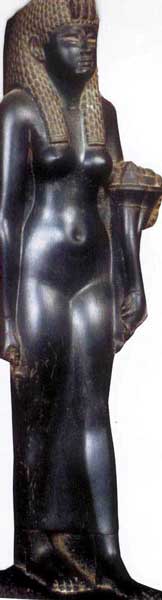
Cleopatra statueConquerors, emperors, ancient travelers and traders have all approached Alexandria from the sea… and so will you! Only Travel in Style makes it possible to experience the very essence of this ancient city as it should be experienced, as it was known by pharaohs, queens, and invaders from Marc Antony to Napoleon.

We’ll set sail into the great harbor, still the destination and port of call for ships from the far corners of the world. Landward, we’ll espy the great and throbbing maritime metropolis of Egypt. Our course will take us directly above statues that lie on the seabed, and stone slabs of the Lighthouse-one of the Seven Wonders of the Ancient World-toppled in an ancient earthquake. We’ll approach the great stone fortress of Qait Bey, reputedly constructed with some of those very stones.

Then we’ll set a course along the coast to the East Harbor, dropping anchor above the Royal City that was submerged by earthquakes and tidal waves in the fourth century A.D.

This underwater treasure house includes the palace of Cleopatra, the Timonium of Mark Antony, fallen columns and capitals, sphinxes, and statues and ceramics, much of it remarkably well preserved. Certified divers among our guests may book an optional excursion to explore this submarine Pompeii.

Along the way, we’ll view the spectacular Bibliotheca Alexandrina—the Library of Alexandria—as few are privileged to see it. Taking the stunning form of an inclined disk rising from the waters, it aptly captures the rebirth from the sea—in Pharaonic fashion—of the lost Alexandria Library of the ancient Greeks that held the works of the greatest scientists and philosophers of the ancient world. Like its namesake, the new Bibliotheca Alexandrina serves as a storehouse of knowledge and a beacon of culture and intellectual expression in this part of the world. Our maritime view is just a preview of our visit to the library itself.

Then we’ll set a course along the coast to the East Harbor, dropping anchor above the Royal City that was submerged by earthquakes and tidal waves in the fourth century A.D. This underwater treasure house includes the palace of Cleopatra, the Timonium of Mark Antony, fallen columns and capitals, sphinxes, and statues and ceramics, much of it remarkably well preserved. Certified divers among our guests may book an optional excursion to explore this submarine Pompeii.

Finally, we’ll conclude an unforgettable voyage through history by setting a course to Abu Qir, where the French fleet under Napoleon was destroyed by Admiral Horatio Nelson. The visit is a perfect counterpoint to a visit to the Qait Bey, where moving relics of the ill-fated fleet are on display.

Please note that this opportunity is limited to up to seven guests at a time. Two small cabins are available for changing and rest, as well as a bathroom, galley, dining salon, and sundeck. Our vessel is fully staffed by a crew of three, including captain. By prior arrangement, we can arrange for a sunset sailing, with cocktails and light music on your vessel’s sound system, or a full day of sport fishing.

We can also make arrangements for you to meet and share dinner as guests of a local family.

This is an extraordinary opportunity to go beyond the limits of the casual visitor, to share your aspirations, outlook, customs, and experiences with people who have a lot more in common with you than you might ever expect. If you’re interested, just let us know, and consider taking along something from your home town to leave with your hosts as a gesture of appreciation.

The recent discoveries join the New Library, opened just last year, among the top attractions in Alexandria. And the New Museum will shortly open in a historic palace that once housed the United States consulate.

Nefertiti Turns Egypt Upside Down!!

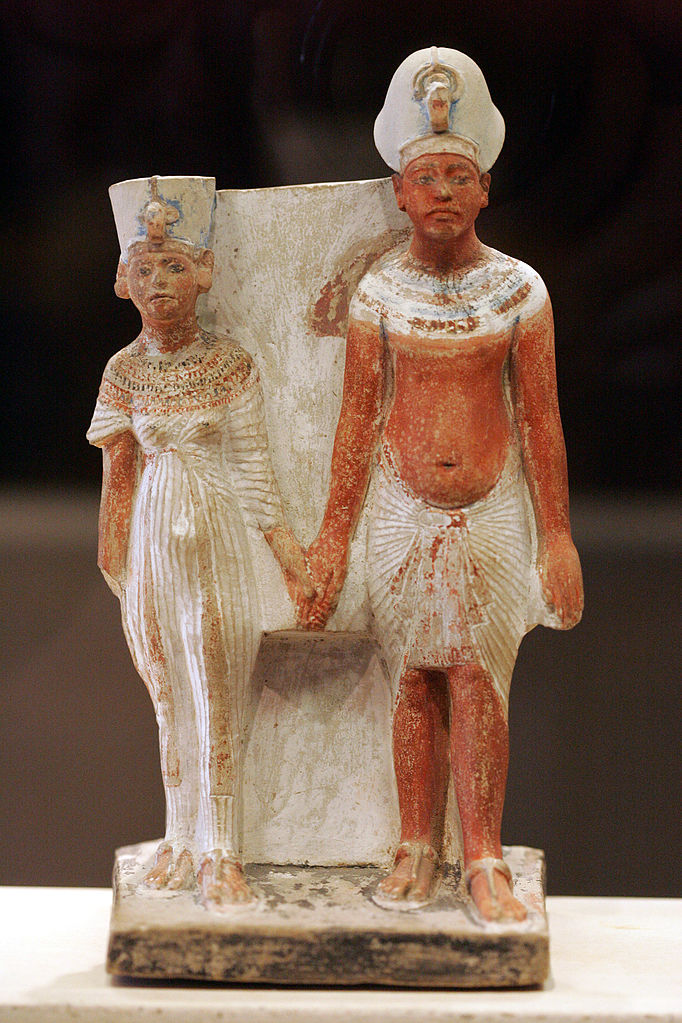
Nefertiti and Akhenathon

Akhenaten and Nefertiti.
By UnknownRama (RamaOwn work)
[CC-BY-SA-2.0-fr], via Wikimedia Commons

 Sail the Nile like Cleopatra and Egyptian Queens.
Sail the Nile the way Nefertiti did it.
The Royal Dongola or the Zarafa Dahabiya.

Nefertiti Turns Egypt Upside Down!! 1350 BC – Queen Nefertiti is reported to have led her Egyptian subjects on a wild spree of idol-smashing, temple-destruction, and forced migration, all part of a campaign of religious reformation.

“From now on, there will be only one Deity, and that Deity is Aten, the Sun Disc,” she has commanded.

Reliable sources in the Nile Valley report that all temples to gods other than Aten have been closed, and that a hefty fine will be imposed on anyone caught with an outlawed statuette.

Idols are to be smashed immediately, and the shards turned over to the priests of Aten.

“The capital of Egypt will now be at Tel El Amarna,” reads a decree widely circulated in cuneiform on clay tablets.

“All priests are to settle within one hour’s journey of the new Temple to Aten. All bidders on public works contracts will likewise have their head offices within the same specified distance.”

Egyptian leaders in exile have disputed the motives behind the upheaval. “It’s just a ploy to concentrate power and wealth in her hands and those of her husband, Ikhnaton,” stated one defrocked priest.

“Everybody knows that Nefertiti has risen to her position on qualities that have nothing to do with religion.

She isn’t called Incarnation of Beauty for nothing,” he added, referring to the literal meaning of her name. The source asked not to be identified, fearing reprisals. Tel El Amarna, Nile Valley, 2004 – from Paul Glassman, special correspondent “Wow,” commented Joe Shiner, an agro-businesman from Des Moines, as he toured the main temple at Tel El Amarna. “It’s one thing to hear that Nefertiti was a real beauty. But it’s quite another to visit in person and learn the real story.” “Until I came here, I didn’t know that she was behind the idea of having only one god-even before the Hebrews and Christians and followers of Mohammed.

“And now that I see her picture, I can understand why people followed her. This is not what I expected . . . not at all!” Mr. Shiner gestured as he spoke to a temple painting of a well-endowed Nefertiti in a chariot, wearing only a see-through cloak and thong-style panties.

“If she was my queen, I’d follow her to the end of the . . . ”
Mr. Shiner’s comments were interrupted by the approach of his wife.

Disclaimer: The facts presented are as accurate as can be ascertained from the archeological record. Mr. Joe Shiner is a composite of the satisfied clients of Travel in Style.

Amarna is an extensive Egyptian archaeological site that represents the remains of the capital city newly established and built by the Pharaoh Akhenaten of the late Eighteenth Dynasty, and abandoned shortly after his death (1332 BC). The name for the city employed by the ancient Egyptians is written as Akhetaten in English transliteration. Akhetaten means “Horizon of the Aten”. – Wikipedia

Central City Amarna (IV)

AWIB-ISAW: Central City Amarna (IV). Mudbrick remains of the Central City area at Amarna and visible just beyond them are the large discard piles left behind by earlier archaeologists. © Kyera Giannini (2009)

The Armana Project is working with the agreement and co-operation of the Egyptian government, and in particular the Supreme Council of Antiquities. They seek to:

  • Explore by archaeology the ancient city of Amarna and its historical context
  • Preserve what is left of the ancient city
  • Promote study and recording of the history, archaeology and traditional life and crafts of the surrounding region
  • Increase public knowledge, at all levels, of the city of Amarna and of the surrounding region

The Search for Imhotep

The Egyptian Da Vinci

Suggested Readings

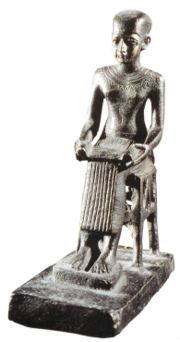
Imhotep

Imhotep (sometimes spelled Immutef, Im-hotep, or Ii-em-Hotep, meaning “the one who comes in peace”) was an Egyptian polymath, who served under the Third Dynasty king, Djoser, as chancellor to the pharaoh and high priest of the sun god Ra at Heliopolis. He is considered to be the first architect and physician known by name in history .

The full list of his titles is: Chancellor of the King of Lower Egypt, First after the King of Upper Egypt, Administrator of the Great Palace, Hereditary nobleman, High Priest of Heliopolis, Builder, Chief Carpenter, Chief Sculptor and Maker of Vases in Chief. As with Hatshepsut and Senemut’s later relationship, Imhotep is one of very few mortals to be depicted as part of a pharaoh’s statue. He was one of only a few commoners ever to be accorded divine status after death. The centre of his cult was Memphis. From the First Intermediate Period onward Imhotep was also revered as a poet and philosopher. His sayings were famously referred to in poems: I have heard the words of Imhotep and Hordedef with whose discourses men speak so much.

The knowledge of the location of Imhotep’s tomb was lost in antiquity and is still unknown, despite efforts to find it. The general consensus is that it is at Saqqara.

Much else ‘known’ about him is hear-say and conjecture. The ancient Egyptians credited him with many inventions. As one of the officials of the Pharaoh, Djosèr, he probably designed the Pyramid of Djoser (the Step Pyramid) at Saqqara in Egypt around 2630-2611 BC [5]. He may have been responsible for the first known use of columns in architecture. He has also been acclaimed to be the inventor of the Papyrus scroll, being its oldest known bearer.

Imhotep is credited with being the founder of Egyptian medicine and with being the author of a medical treatise remarkable for being devoid of magical thinking, the so-called Edwin Smith papyrus, detailing anatomical observations, ailments, and cures. The surviving papyrus was probably written around 1700 BC but may be a copy of texts a thousand years older. This attribution of authorship is speculative, however.

He was said to be a son of Ptah, his mother being a mortal named Khredu-ankh.

Two thousand years after his death, his status was raised to that of a deity. He became the god of medicine and healing. He later was linked to Asclepius by the Greeks. The Encyclopedia Britannica says, “The evidence aforded by Egyptian and Greek texts support the view that Imhotep’s reputation was very respected in early times… His prestige increased with the lapse of centuries and his temples in Greek times were the centers of medical teachings.”

As the “son of Ian”, his mother was sometimes said to be Sekhmet, the patron of Upper Egypt because Ptah often was said to have married her. As Imhotep was considered the inventor of healing, he was also sometimes said to be the one who held up the goddess Nut (the deification of the sky), as the separation of Nut and Geb (the deification of the earth) was said to be what held back chaos.

Due to the position this would have placed him in, he was also sometimes said to be Nut’s son. In artwork he also is linked with the great goddess, Hathor, who eventually became identified as the wife of Ra. He also was identified with Maat, the goddess who personified the concept of truth, cosmic order, and justice—having created order out of chaos and being responsible for maintaining it. An association with Amenhotep son of Hapu, who was another deified architect, also occurred.

It is Imhotep, says Sir William Osler, who was the real Father of Medicine. “The first figure of a physician to stand out clearly from the mists of antiquity.”

An inscription from Upper Egypt, dating from the Ptolemaic period, mentions a famine of seven years during the time of Imhotep. According to the inscription, the reigning pharaoh, Djoser, had a dream in which the Nile god spoke to him. Imhotep is credited with helping to solve the famine. The obvious parallels with the biblical story of Joseph have long been commented upon. [7]. More recently, the Joseph parallels have led some alternative historians to identify Imhotep with Joseph, and to argue that the supposedly thousand years separating them are indicative of a faulty chronology.

Search For Imhotep

“I am probably standing on my grave,” he said. And he was.
Written by Raymond M. Wilkinson
Photographed by Nik Wheeler

About six months ago, Walter Emery, portly Englishman of nearly 68 years with a reputation as the world’s top Egyptologist, pulled a large trilby hat down on graying temples and pointed his cane at a shallow pit where workmen were scooping away sand from the entrance to a limestone passageway. “I am probably standing on my grave,” he said.

He was. On March 7, Walter Emery, after 48 years of “digging holes in Egypt,” collapsed on the site of that passageway—the passageway where he had expected to spend the rest of his life and which he was sure would one day lead him to the greatest discovery of his career: the tomb of Imhotep. Four days later he died, his search unfinished, the mystery of Imhotep unsolved.

Like the famous King Tut, whose tomb Howard Carter unearthed in Luxor in 1922, Imhotep—doctor, architect, philosopher, magician and politician—has long fascinated Egyptologists. He was surely one of the most intriguing figures of ancient Egypt. Although the books he is supposed to have written have vanished and there is no record of his private life, signs of his presence are everywhere, the most unmistakable being the small but unique Step Pyramid on the plateau of Sakkara, 20 miles from Cairo.

The Step Pyramid, the world’s oldest standing structure, is not impressive in either size or symmetry—the Great Pyramid at Giza is 250 feet higher—but in designing it, Imhotep introduced a new architectural form. To some sources that makes him the world’s first engineer. In Egypt it won him great honors and sonorous titles: “Chancellor of the King of Lower Egypt,” “Hereditary Prince,” “Greatest of Seers,” and “Ruler of the Great Estates.”

Curiously, Imhotep’s achievements as a physician, for which he is most widely known today, were not widely recognized until 2,000 years after his death. But then his name became so popular that Egyptians swarmed to his tomb seeking cures. Eventually they deified him as the God of Medicine. Even the Greeks and Romans, despite their own advances in medicine, granted him recognition. The Greeks identified him with their own God of Medicine, Eskalapies, and Cleopatra reportedly placed a dedication to him in the Temple of Philae.

Almost as quickly as it was revived, however, Imhotep’s reputation again disappeared under the sands of the desert—along with most traces of his accomplishments. It was not until 1920 that it was revived for the second time. That came about when Cecil Firth, a colleague of Emery’s, began to excavate a vast complex of subsidiary buildings around the Step Pyramid near Emery’s then-current dig. He discovered a statue apparently dedicated to the builder of the Step Pyramid and translated the name. It was Imhotep.

Excited by the discovery, Firth began to look for Imhotep’s tomb. He was convinced that it was within a few hundred yards of the Step Pyramid and searched there until his death in 1932.

Emery, in the meantime, had also been poking into the sands of Sakkara, a place he once called “one of the most fabulous treasure houses of man’s history.” Shortly after World War I he had made what he considered his major discovery: the tombs of the first dynasty of kings. After Firth’s death he took up the search for Imhotep, and despite other work in the Sudan and other parts of Egypt and World War II, kept at it intermittently until his collapse in March

Like Firth, Emery was sure that the tomb was near the Step Pyramid. In part his conviction was based on accounts written by Napoleon’s scientists when they first began to open up the wonders of Egypt in the early 19th century. At Sakkara these scientists had discovered what they called the “Tomb of the Birds,” and described how they “were lowered into pits which led to great passages covering vast areas full of birds.” Since the sacred bird of Imhotep was the ibis, and one of his titles was “The Great One of the Ibis,” Emery concluded that what the French had found was at least near Imhotep’s tomb. When he found another reference saying Imhotep was buried near the “Lake of the Crocodiles,” he conjectured that what is now a vast depression of sand in Sakkara was once a lake.

It was not until 1962, however, that Emery came across his first tangible clue: a huge trail of pottery fragments stretching hundreds of yards across the desert. Examination disclosed that they were fragments of vessels used in religious rites and that they dated back to the period when pilgrims began to approach Imhotep’s tomb. That, plus two old Royal Air Force photographs of the area, which showed the darker outline of ruined buildings two feet under the sand, convinced Emery that this was the place to dig, and dig he did.

The first discoveries, said Emery last winter, were very promising. “Almost immediately we found a Third Dynasty tomb. Then, going down into one of the burial shafts, we found around this tomb the bodies of sacrificial bulls, designating a sacred man.”

More significantly, they found a series of long underground galleries packed with mummified ibises, the sacred bird of Imhotep. There were more than a million of the birds, all packed in earthenware pots. Apparently, they had found the “Tomb of the Birds” referred to by Napoleon’s scientists.

Emery quickly pushed ahead, but ran into an unexpected difficulty: the sheer richness of the archeology. In Sakkara history is literally piled on top of itself. In places, the ruins of buildings from several dynasties were piled one on top of the other. Moreover, in uncovering one area, early explorers more often than not dumped the sand on an as yet undiscovered tomb nearby. For Emery that meant moving from his own 500-square-yard site thousands of additional tons of sand flung there by other scientists, and sometimes digging underneath ancient buildings.

It seemed hopeless at first but Emery, to the consternation of his colleagues, decided on a most unorthodox step. He brought in a bulldozer and in a few days cleared away what could have taken years. Some of his colleagues, he chuckled later, went into shock.

As the search for Imhotep continued, Emery found a series of passageways containing hundreds of mummified baboons, ancient Egypt’s symbol of wisdom and knowledge. In another he found mummified hawks. Shortly after that he found a small piece of stone in a wooden box deposited in a niche hewn into the rock wall of the hawks’ chamber. It was barely eight inches long but inscribed on it in ancient demotic text were the electrifying words: “Imhotep the Great. The son of Ptah the Great God and other Gods Who Rest Here.”

What did Emery hope to find? Treasure? Mummies? Emery was not sure, but he thought it unlikely. The grave robbers of the period would hardly have passed up the treasures that would have been put in Imhotep’s tomb. But the thieves, Emery hoped, might have left scrolls of papyrus, and the scrolls could well contain descriptions of medical practices, architectural designs, notes on everyday life. If so, he said once, it would be the greatest discovery since Carter groped into the tomb of King Tut. Asked if he thought he could be wrong about the location, Emery shook his head vehemently. “Imhotep is here,” he said, ” and I will find him.”

His faith may yet be justified. In Cairo, Geoffrey Martin, Emery’s longtime assistant, has announced that the search for Imhotep will go on.

Raymond M. Wilkinson is a correspondent for United Press International. Formerly Bureau Chief in Cairo, he is now assigned to Paris. This article appeared on pages 32-36 of the July/August 1971 print edition of Saudi Aramco World. www.saudiaramcoworld.com/issue/197104/search.for.imhotep.htm. See Also: ARCHEOLOGY AND ARCHEOLOGISTS, EGYPT, ANCIENT, EMERY, WALTER, IMHOTEP, TOMB OF, PERSONALITIES, TOMBS. Check the Public Affairs Digital Image Archive for July/August 1971 images.

Pyramids

You may wish to know that you can request a free copy of the issue of Saudi Aramco magazine in which you can find an incredible wealth of information on Egypt’s History, People etc., the Middle East, Arabs, Muslims and more, by writing to:

Special Requests
Saudi Aramco World
Box 2106
Houston, Texas 77252-2106
by faxing to 713-432-5536,
or by e-mailing EK.Catchings@AramcoServices.com

Tomb of the Mighty Pharaoh Seti I

Father of Ramses the Great

Private Tour

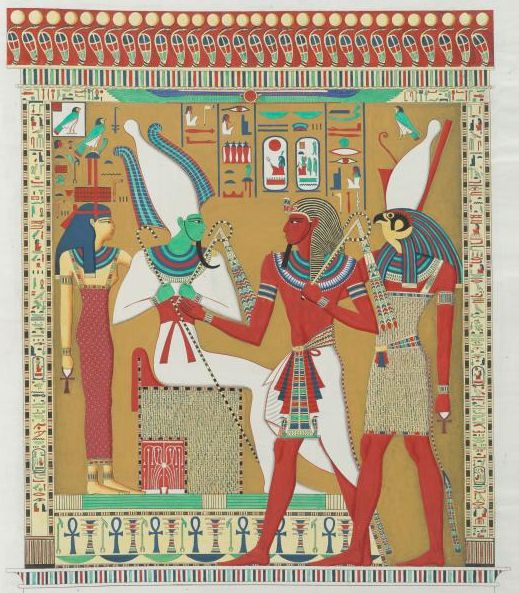
Osiris, Seti and Horus by Salvador Cherubini

Osiris, Seti and Horus by Salvador Cherubini

Head to the West Bank for a true very special experience:
Nile Adventure Tour With A Private Tour of Seti I Tomb

Tomb of Seti I: The Mighty Pharaoh
For preservation purposes, the tomb is closed to the general public and visiting requires special permits. Please book at least 60 days in advance.

Our tour includes special and private access to Seti I ’s tomb, the largest and most exquisitely decorated of the 62 sepulchers in the Valley of the Kings. Although famous for being the father of Ramses II, Seti I was considered a great leader during his 11 year reign, known for his military achievements and cultivation of the arts. Despite Seti I’s short life, his tomb is the most completely decorated, preserved and finished in the valley. Every inch of the passageways and chambers in the 446 foot long tomb are not just painted, but are also fully decorated with highly refined bas-relief. The quality and extensiveness of the design set the standard for all the Pharaohs that came after.

The discovery of this spectacularly preserved tomb in 1817 by the circus strongman-turned-Egyptologist, Giovanni Battista Belzoni, made headlines that ignited Egypt-mania throughout Europe. Excitement for Seti I’s tomb struck again in 2007 when further excavation by Egyptian antiquities chief, Dr. Zahi Hawass found a 570 foot passageway descending from the tomb. Entering into Seti I’s tomb, we will capture the spirit of discovery of these archeologists as we explore one of Egypt’s most treasured and rare experiences. Our touring done, we return by air to Cairo, and your hotel, where dinner awaits you.

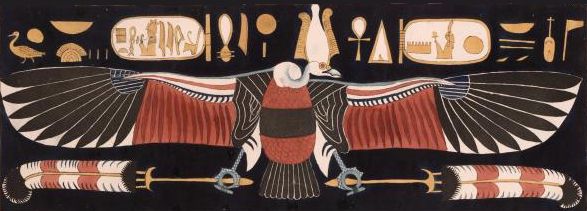
The vulture Nekhbet, guardian of the tomb of the Mighty Pharaoh Seti I's Seti I by J. Ricci, an artist in the Belzoni expedition, 1820.

The vulture Nekhbet, guardian of the tomb of the Mighty Pharaoh Seti I’s Seti I
by J. Ricci, an artist in the Belzoni expedition, 1820.

The Discovery of the Most Enchanting Tomb of Seti I Father of Ramses the Great (Ramses II)
By Giovanni Battista Belzoni (published 1820)
On the 16th October, 1817 I recommenced my excavations in the valley of Beban el Malook (the Valley of the Kings), and pointed out the fortunate spot, which has paid me for all the trouble I took in my researches. I may call this a fortunate day, one of the best perhaps of my life; I do not mean to say, that fortune has made me rich, for I do not consider all rich men fortunate; but she has given me that satisfaction, that extreme pleasure, which wealth cannot purchase; the pleasure of discovering what has been long sought in vain, and of presenting the world with a new and perfect monument of Egyptian antiquity, which can be recorded as superior to any other in point of grandeur, style, and preservation, appearing as if just finished on the day we entered it; and what I found in it will show its great superiority to all others.

I caused the earth to be opened at the foot of a steep hill, and under a torrent, which, when it rains, pours a great quantity of water over the very spot I have caused to be dug. No one could imagine, that the ancient Egyptians would make the entrance into such an immense and superb excavation just under a torrent of water; but I had strong reasons to suppose, that there was a tomb in that place, from indications I had observed in my pursuit.

The local peasants who were accustomed to dig were all of opinion, that there was nothing in that spot, as the situation of this tomb differed from that of any other. I continued the work however, and the next day, the 17th, in the evening, we perceived the part of the rock that was cut, and formed the entrance.

On the 18th, early in the morning, the task was resumed, and about noon the workmen reached the entrance, which was eighteen feet below the surface of the ground. The appearance indicated that the tomb was of the first rate: but still I did not expect to find such a one as it really proved to be.

The local peasants advanced till they saw that it was probably a large tomb when they protested they could go no farther, the tomb was so much choked up with large stones which they could not get out of the passage. I descended, examined the place, pointed out to them where they might dig, and in an hour there was room enough for me to enter through a passage that the earth had left under the ceiling of the first corridor. I perceived immediately by the painting on the ceiling, and by the hieroglyphics in bas-relief, which were to be seen where the earth did not reach, that this was the entrance into a large and magnificent tomb.

At the end of this corridor I came to a staircase twenty-three feet long. From the foot of the staircase I entered another corridor, each side sculptured with hieroglyphics in bas-relief, and painted. The ceiling also is finely painted, and in pretty good preservation.

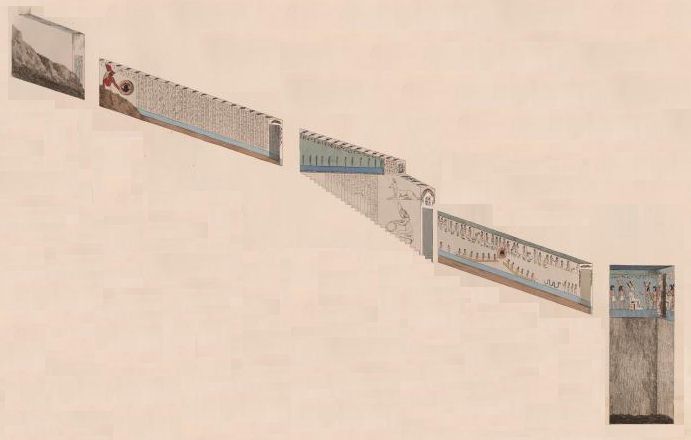
The more I saw, the more I was eager to see, such being the nature of man: but I was checked in my anxiety at this time, for at the end of this passage I reached a large pit which intercepted my progress. This pit is thirty feet deep, and fourteen feet by twelve feet wide. The upper part of the pit is adorned with figures. The passages from the entrance all the way to this pit have an inclination downward of an angle of eighteen degrees.

The descending passage of the Mighty Pharaoh Seti I 's tomb. By J. Ricci, 1820.

The descending passage of the Mighty Pharaoh Seti I ‘s tomb. By J. Ricci, 1820.

On the opposite side of the pit facing the entrance I perceived a small aperture two feet wide and two feet six inches high, and at the bottom of the wall a quantity of rubbish. A rope fastened to a piece of wood, that was laid across the passage against the projections which form a kind of door, appears to have been used by the ancients for descending into the pit; and from the small aperture on the opposite side hung another, which reached the bottom, no doubt for the purpose of ascending. We could clearly perceive, that the water which entered the passages from the torrents of rain ran into this pit, and the wood and rope fastened to it crumbled to dust on touching them.

At the bottom of the pit were several pieces of wood, placed against the side of it, so as to assist the person who was to ascend by the rope into the aperture. I saw the impossibility of proceeding at the moment.

The next day, the 19th, by means of a long beam we succeeded in sending a man up into the aperture, and having contrived to make a bridge of two beams, we crossed the pit. The little aperture we found to be an opening forced through a wall, that had entirely closed the entrance, which was as large as the corridor. The Egyptians had closely shut it up, plastered the wall over, and painted it like the rest of the sides of the pit, so that but for the aperture, it would have been impossible to suppose that there was any farther proceeding; and any one would conclude that the tomb ended with the pit.

The rope in the inside of the wall did not fall to dust, but remained pretty strong, the water not having reached it at all; and the wood to which it was attached was in good preservation. It was owing to this method of keeping the damp out of the inner parts of the tomb, that they are so well preserved. I observed some cavities at the bottom of the well, but found nothing in them, nor any communication from the bottom to any other place; therefore we could not doubt it being made to receive the waters from the rain, which happens occasionally in this mount

When we had passed through the little aperture, we found ourselves in a beautiful hall, twenty-seven feet by twenty-five feet, in which were four pillars three feet square. In the front of this first hall, facing the entrance, is one of the finest compositions that ever was made by the Egyptians, for nothing like it can be seen in any part of Egypt.

It consists of four figures as large as life. The god Osiris sitting on his throne, receiving the homage of a hero, who is introduced by a hawk-headed deity. Behind the throne is a female figure as if in attendance on the great god. The whole group is surrounded by hieroglyphics, and enclosed in a frame richly adorned with symbolical figures. The winged globe is above, with the wings spread over all, and a line of serpents crowns the whole. The figures and paintings are in such perfect preservation, that they give the most correct idea of their ornaments and decorations. At the end of this room, which I call the entrance-hall is a large door, from which three steps lead down into a chamber with two pillars. This is twenty-eight feet by twenty-five feet. I gave it the name of the drawing-room; for it is covered with figures, which, though only outlined, are so fine and perfect, that you would think they had been drawn only the day before.

Tomb of Seti I: The Mighty Pharaoh

The tomb of Seti I (KV17) is famous for being the largest and one of the most spectacularly decorated sepulchers of the New Kingdom pharaohs. Hidden in the Valley of the Kings, the ancient, royal burial ground near modern day Luxor, Seti I’s tomb set the precedent for the tomb art of subsequent pharaohs. The quality of the work is fitting, as Seti I was thought to have reined during the high point of Egyptian art.

Although he is now overshadowed by the fame of his son, Ramses II, Seti I was considered a great king during his time, known for his cultivation of the arts and his military achievements. Extensive building began during his short rein, including Karnak and the Hypostyle hall in the Temple of Amun. A majority of his military campaigns were victorious and during his 11 years in power he reclaimed most of Egypt’s disputed territories. Examination of Seti I’s well preserved mummy show that he died around the age of 40 from unknown causes. There is no evidence of violence and experts believe it may have been related to heart failure.

Unlike the other kings of the New Kingdom, Seti I’s tomb was nearly completed during his lifetime, which is particularly impressive because his rein was so short and the work was so extensive and exquisite. While tombs of previous kings only decorated the sarcophagus chamber, Seti I was the first to have colorful paintings and bas-relief covering the walls of every passageway and chamber. The artwork includes the most complete depictions of the Underworld Books, including the Amduat and the Book of Gates. The layout of Seti I’s tomb was architecturally based on Horemheb’s tomb, but it was the first to have a burial chamber with a high, vaulted ceiling.

When discovered in 1817 by the circus strongman-turned-Egyptologist Giovanni Battista Belzoni, most of the tomb’s treasures were already plundered. However the spectacular bas-relief artwork and the sheer size of the tomb ignited a fascination for Egyptian art and antiquities that spread across Europe.

KV17 was most likely looted relatively shortly after completion, probably during the late New Kingdom. To prevent further looting and desecration, Seti I’s actual mummy was moved by the Twenty-first Dynasty priests to Deir El-Bahari and was not found until 1881. His mummy is now housed in the Cairo museum.

Another fascinating aspect of Seti’s tomb is the tunnel leading down from the burial chamber. The passageway was originally discovered in 1960 but recent excavation performed by Egyptian antiquities chief, Dr. Zahi Hawass found that the tunnel is much longer than originally thought. The purpose of the tunnel is unknown, but it is speculated that it was either built as a passageway to the “true” burial chamber or as “an attempt to reach the mythical waters of the primeval ocean Nun.”

During the three years it took to excavate the passageway, archaeologists found shards of pottery and pieces of statuettes. They also discovered the walls of the tunnel were marked with preliminary sketches for decoration. In 2010 Zahi Hawass’s team hit a dead end in the excavation of the tunnel. He believes construction of the tunnel stopped because of the Pharaoh’s death.

The Mighty Pharaoh Seti I Father of Ramses The Great

The Mighty Pharaoh Seti I Father of Ramses The Great

Dress Code and What To Pack

Going to Egypt and Cruising the Nile

View from the sundeck of the Nile Goddess

Dress Code

All of our Nile cruise vessels are fully air conditioned. On board dress is casual except at dinner, when smart casual is the rule. Lightweight cotton and other natural fiber clothing is best, with swimsuits and sun hats for the sundeck and pool. Bring a light sweater or light jacket for cool mornings and evenings, but most days are warm to hot, with very little rain. Comfortable walking shoes are essential for shore excursions.

What to Pack:
Most of the year look forward to warm, even hot weather in Cairo, Luxor and Aswan. Morning and evenings are cooler. During winter… very rarely do we get rain, if so, very brief showers. No need for real rain wear/gear. Before sunrise, after sunset, you will need a light jacket, or light sweater. For Nile cruise shore excursions, we suggest comfortable cotton & natural fabric lightweight clothing.

Comfortable walking shoes are essential for all tours in Cairo or Upper Egypt.
Clothing on Board the Nile Cruise:
Lightweight comfortable & casual clothing. Swimsuits, sun hat. Dining room dress code is casual for breakfast & lunch, but smart casual for dinner. Please do not wear swimsuits into the dining room. All ships are fully air conditioned.

Dining Room Reservations. Meet other passengers:
YOU will not require any, our dining rooms do accommodate all our guests in one seating, one less thing to worry about while you are on the Nile. Enjoy the cosmopolitan atmosphere with several different languages being heard at dinner.

Dining Notes:
The set-menu meals included in your tour are indicated in the itinerary: B = Breakfast, (or cB, Continental Breakfast), L = Lunch, D = Dinner. On our luxury Nile cruise vessels, our spacious dining rooms accommodate all passengers at one seating, so there is no need to worry about making reservations, one less thing to worry about while you are on the Nile. Enjoy the cosmopolitan atmosphere with several different languages being heard at dinner. Smart casual dress is suggested for dinner. No tie / formal dress requirement.

Do we get sea sickness while sailing the Nile?
This is river sailing, so do not expect any waves – no rough seas! Your Nile cruises is actually a floating hotel that moves from place to place along the Nile. Actual cruising times are short.

Our Nile cruise passengers come from all countries of the world, more from Europe, but also from North America, South America and Asia, and naturally they’ll often keep the company of their own language and culture.

Your patience and extra efforts to interact are sure to reap rewards. Some guests from the USA did bring up the issue that in some cases the boat did have 2 or 3 English speaking couples on board, and that they expected more! Most sailings have a few native English speakers, though the numbers, of course, vary by season, and are not guaranteed.

The King’s Chamber in the Great Pyramid was not meant to be visited:
Getting to it is challenging, and once you enter, it is very difficult to turn back. The stone passage is only wide enough for one person. You must be in good physical condition, able to climb several flights of stairs, bend double, crouch and duck-walk for short distances. The King’s Chamber itself is the world’s most claustrophobic place, with dim light and heavy, hot, oxygen-poor air. There is no ventilation. If you are at all sensitive to claustrophobia or confinement, or if you have any sort of respiratory condition, for your own safety and the safety of others, you must not enter the pyramid because it is impossible to remove a person or to bring aid to them quickly.
Suggested tips

Per Person, never required, always appreciated:

Drivers: $ 3 USD for Transfers or $5 for Full Day
Guides: 10 USD for Full Day
Nile Cruise: $10 USD per day for all the crew on board (give to the Reception Desk at the end of the cruise)


PLANNING YOUR EGYPTIAN EXPERIENCE

Climate
Summer highs in Cairo range well into the 90’s, while Aswan and Luxor may reach the 100’s. Overnight lows average in the 70’s during the summer. In the winter, temperatures in Cairo run around 70 degrees, with nighttime lows of around 50. Aswan and Luxor will be somewhat warmer during the day and cooler at night. The extremely low humidity makes the temperature feel considerably cooler than it is. Visitors are pleasantly surprised at how comfortable the temperature can be.

Visas and Passports
Visas are required for entry into Egypt, and are available from Egyptian consulates and diplomatic missions. In addition, passports should be valid for at least six months from the date of entry into Egypt.

Money
The Egyptian Pound (L. E.) is divided into 100 Piasters (P.T.), traveler’s checks and major credit cards such as Visa and American Express are widely accepted at major hotels and restaurants.

Health Requirements
No inoculations are currently required for entry into Egypt from the United States or Canada. Tap water, raw food, unpasteurized milk and dairy products, fruit that one has not peeled personally and salads should be avoided.

Government and Economy
Since 1953, Egypt has been a constitutional democracy, with an elected president. Egypt’s main sources of foreign exchange are oil, tourism, the Suez Canal tolls, agriculture and light and heavy industry.

Weights and Measures
Egypt is on the metric system. One kilometer equals .62 miles, and a quick kilometers-to-miles conversion method is to multiply the number of kilometers between places by 60%, which will produce a close approximation.

The country’s electrical supply may vary from 220 volts, with standard European sockets and plugs, to 110 volts. Electrical converter kits are a good idea for travelers carrying electric appliances such as razors and hair dryers.

Holidays and Business Hours
Moslem holidays are observed in Egypt depending on the Islamic lunar calendar, which changes every year. It shouldn’t affect your vacation plans unless you are going for business, then it’s a good idea to plan around the holidays since many businesses and banks observe them.

Embassies and banks are closed on Fridays and Saturdays. Shops are generally open from 9AM to 8 PM, and are closed on Sundays. Main bank branches are generally open from 8:30 AM to 2 PM, Sunday through Thursday, while government offices are open between 7 AM and 2PM, Sunday through Thursday.

Shopping
Leather, gold, silver, copper, hand-made rugs, brassware and alabaster are among the buys to be made in Egypt’s bazaars and shops. Travelers should be sure to haggle a bit to obtain the best price and to savor the experience of shopping in Egypt.

Recreation
Hotels commonly offer such sports amenities as tennis, swimming and fitness facilities. In addition, because of Egypt’s three coastlines — the Nile, the Mediterranean and the Red Sea — there is an abundance of water sports, including Red Sea scuba diving and sport fishing particularly in the Nubia: Lake Nasser.

Time
Egypt is two hours ahead of Greenwich Mean Time, except during the summer months, when the difference is three hours. Greenwich Mean Time is 5 hours ahead of Eastern Standard Time.

Attire
During the day, lightweight cotton clothing is advisable year round. During the cooler months — November through March — a sweater, wrap or lightweight jacket will be welcome after dark.

Comfortable, durable shoes are advisable at any time for sightseeing and shore excursions. A hat to ward off the sun and a scarf as protection are always a good idea.

Egyptians tend to dress up when dining out or nightclubbing in Cairo’s better restaurants and night spots, so travelers may wish to bring along some dressy clothing, depending on their itinerary.

Travelers should remember to observe local etiquette when visiting mosques. Women are requested to cover their arms, legs and backs, and not to wear halters or short sleeves. A scarf or other head covering should be worn by women as well, and both men and women must remove their shoes before entering a mosque.

Religious Etiquette
Once inside a mosque, visitors should be careful not to pass in front of worshipers. Visitors are advised to avoid mosques on Friday, since that is the Moslem Sabbath.

Camera Tips
Because much of Egypt is dry and sometimes dusty, travelers are advised to keep camera lenses protected with lens caps and to have a tote bag or case to protect the camera from the fine desert sand. It’s a good idea to bring an assortment of filters and flash attachments to accommodate the contrasts between bright exterior sunlight and the dim interior light in tombs and excavations. It’s also advisable to bring plenty of high-speed film, since flashes are prohibited in many temples.

Alcoholic Beverages
These are not included in the program. Wine, beer and other alcoholic beverages are generally available at most restaurants, hotels and other popular tourist spots.

Egypt is one of the world’s oldest civilizations, with a history dating back thousands of years before the birth of Christ. At the same time, Egypt is a young nation, with a constitutional democracy which was founded in 1953. It is this combination of old and new that helps makes Egypt such a fascinating country.

Egypt is modern, air-conditioned cities side by side with the Pyramids, the Sphinx, the Temples at Luxor and many other astonishing wonders. Egypt is a boundless repository of unique sights, sounds and historical treasures. And Egypt is a traveler’s delight, waiting to be discovered.

Located on the northeastern coast of Africa, Egypt has an extensive coastline on the Mediterranean and the Red Sea. Just a short flight from Rome, Madrid and other major European cities, Egypt is centrally located, and is convenient to Istanbul, Algiers, Tunis and many other Middle Eastern countries and cities.

A surprising large nation, Egypt has a population of some 63 million, spread over more than 600,000 square miles. And throughout the entire country flows Egypt’s lifeblood, the Nile, the world’s longest river.

Although Arabic is the official language, English and French are widely spoken.

Principal cities include Cairo, the capital and Egypt’s largest city; Alexandria, the second largest city located on the Mediterranean; Luxor, home of the Temples of Luxor and Karnak; Aswan, site of the Aswan High Dam; and Giza, home of the three great pyramids of Cheops, Kephren and Mycerinos.

Egypt offers museums and antiquities unmatched anywhere else on Earth. The visitor can experience ruins dating back more than 5,000 years, diving in the Red Sea, dining in elegant restaurants or cruising through history on the Nile. It is truly a wondrous land creating lifetime memories for incentive winners and meeting attendees.

CAIRO, on the banks of the historic Nile, is one of the world’s oldest and most fascinating cities. Founded more than 1000 years ago, Cairo is one of the five largest cities in the world. Its long tradition as a cultural, social and political center makes Cairo an exciting, intriguing destination.

Cairo enchants the visitor with the diversity of settings that make it a blend of East and West — ancient and modern. The domes and spires of famous Islamic mosques and Coptic churches glitter in the sunlight and dominate the city’s skyline. Rich in history, Cairo and the nearby cities on the Nile offer a treasure trove of antiquities and museums that have awed travelers for centuries.

It is really two distinct cities: a modern city facing the Nile with skyscrapers, apartments, offices, theaters and smart shops. It is an ancient city of history, culture and traditions unique on Earth.

From the rich history of the Egyptian Museum of Antiquities…to the ancient pyramids and the sphinx…to the hustle and bustle of the ancient Bazaar…to the exquisite Citadel and towering mosques…to the diverse craft that ply the Nile to the dazzling nightlife…Cairo is one of the world’s great treasures.

GIZA, Home to the famed Pyramids, Giza sits on the West Bank of the Nile and is today a suburb of Cairo.

Considered one of the wonders of the world, the pyramids of Cheops, Kephren and Mycerinos dating from the 4th Dynasty, about 2500 BC are located here as is the Sphinx. Giza is also home to a variety of business’s and cultural resources as well as homes, parks, a zoo and a number of other entertainments. Today, Giza is a city over of 2 million people.

Information is subject to change without notice, particularly, exchange rates, prices etc.

Egypt in a Week (Aswan)

Colossi of Memnon, guarding the passage to Theban Necropolis

Colossi of Memnon, guarding the passage to Theban Necropolis
By Przemyslaw Idzkiewicz. (Own work) [CC-BY-SA-2.5], via Wikimedia Commons

Here’s the best of Egypt in a week: a good look at Cairo and a 5-day cruise along the Nile.

Tour

DAY 1 – CAIRO- VIP Meet & Greet Service – Cairo Airport
Tour Starts Weekly in Cairo – Arrive Saturday ( For Daily Arrival – Please Click Here)
Our local representative will greet you at the airport and whisk you to your hotel. Visa fee is included and will be issued upon arrival at Cairo Airport.

VIP Meet & Greet Upon arrival at Cairo Airport?
Visa issued locally in Cairo (for a limited number of nationalities) no photos required. Our representative greets you at the airport and whisks you to your hotel. Visa will be issued upon arrival at Cairo Airport for a limited number of citizens such as: American, Australian, NZ, EU, Canadian, EU Singaporean and Japanese citizens. You are responsible for having your passport in order valid at least for 6 month beyond the date of your arrival in Cairo. Our local rep. will meet you with a sign that carries your name, and will be waiting for you with the prepaid visa stamps to proceed to the passports control to stamp your passports and then you claim your luggage. After you clear the passport and customs formalities and exit the terminal, our local representative will escort you by private vehicle to the hotel. Welcome fruit basket & Egyptian pastry awaits you in your room with our compliments.

DAY 2 – CAIRO – Sunday (BL)
Breakfast. Lunch. On your first full day in Egypt we show you the Egyptian Museum, including the”Mummies Room”, and King Tut’s gold treasure room, the Pyramids of Giza, the Sphinx, the Citadel of Saladin, and the Mohammed Ali Mosque, made of alabaster. Lunch is included at a local restaurant. This is a very full day, for a more balanced itinerary, you may choose the 9 or the 10 day edition.

DAY 3 – ASWAN, Board your Nile Cruise! – Monday (BLD)
Breakfast. Lunch. Dinner. We fly to Aswan (or Luxor) and board our Nile cruiser in time for a delicious lunch. Complimentary welcome fruit basket awaits you in your cabin. In the afternoon we enjoy a leisurely sail by graceful felucca on the Nile.

DAY 4 – ASWAN – KOM OMBO – Tuesday (BLD)
Breakfast. Lunch. Dinner. First we tour the awesome Aswan dams, and next an ancient granite quarry complete with an unfinished obelisk. Then we go by motor launch to the Island temple of Philae, dedicated to the Ancient Goddess ISIS. Re-embarking on our Nile cruiser, we sail downstream to Kom Ombo to visit its twin temples.

DAY 5 – EDFU – Luxor – Wednesday (BLD)
Breakfast. Lunch. Dinner. We moor in Edfu, climb aboard horse-drawn carriages, and clip-clop through the town to the Temple of Horus, Egypt’s best-preserved temple. Re-embarking, we cruise further north, evening finds us in Luxor.
Your guide will call on you in Luxor for an evening horse-drawn carriage ride throughout Luxor Souks and water-front.

DAY 6 – LUXOR – Thursday (BLD)
Breakfast. Lunch. Dinner.
We tour today as well the magnificent tombs in the Valley of the Kings, including Tutankaomn’s tomb, and the great temple of Queen Hatshepsut, we stop at the Colossi of Memnon on the way back to our cruise.

Afterward, we’ll continue on Luxor’s west bank to get a totally different perspective on ancient Egyptian life, at the ancient workers’ settlement of Deir el-Medinah. While most of the imposing stone monuments and sites of Egypt honor the lives and after-lives of royalty, Deir el-Medinah gives us unique and surprising insights into the ordinary citizens who constructed and decorated the tombs.

Here we’ll see the excavated homes shared by laborers with their domestic animals. These quarters were surprisingly large, with three good-sized rooms, courtyard, kitchen, and even storage cellars. While ancient Egypt might not have been a workers’ paradise, we’ll see that artisans and builders were highly regarded in their community. We are proud to be the only operator to offer regular visits to this singular ancient settlement in its tour and cruise programs. Evening Sound and Light show at Karnak, please bring a jacket and a flash light.

DAY 7 – LUXOR – CAIRO – Friday (B)
The gigantic Great Temple of Amon at Karnak, and the mighty Temple of Luxor are our goals in the morning, followed by a return flight to Cairo and your hotel.

DAY 8 – CAIRO – Departure – Saturday (B)
Breakfast. Our representative escorts you to the airport for your homeward flight. Bon voyage!

 Rate per person in USD: Rates for the 8 day program
Deluxe
Hotel & Nile Cruise
First Class
Hotels & Nile Cruise
Modest
Tourist Class
Hotels & Nile Cruises
Triple Occupancy
US$ 1713.
US$ 1590.
US$ 1330.
Double
US$ 1793.
US$ 1633.
US$ 1487.
Single
US$ 2578.
US$ 2363.
US$ 2075.
 For Dec 15 – Jan 3 and Easter, please add 20% supplement to any of the listed rates.


Rates include:

  • All domestic airfare within Egypt in economy class with tax.
  • All transfers in Egypt, always on a private basis.
  • Hotel accommodation with tax & service charges.
  • Bottled water ( one per person) delivered to your cabin daily while you are on board the cruise.
  • Tea or coffee / and bottled water with each meal while on board the cruise.
  • Nile Cruise with all meals, one large bottle water ( per person ) daily while on board the cruise & a welcome fruit basket
  • All the shore excursions while on board the Nile Cruise and a complimentary welcome drink.
  • Preset menu meals including B = Breakfast, (or cB, Continental Breakfast) L = Lunch, D = Dinner
  • All guided sightseeing as per itinerary including all entrance fees. On board the cruise you’ll be part of an average 10-15 English speaking group.
  • VIP Meet & Greet Upon arrival at Cairo Airport?
    Visa issued locally in Cairo (for a limited number of nationalities) no photos required. Our representative greets you at the airport and whisks you to your hotel. Visa will be issued upon arrival at Cairo Airport for a limited number of citizens such as: American, Australian, NZ, EU, Canadian, EU Singaporean and Japanese citizens. You are responsible for having your passport in order valid at least for 6 month beyond the date of your arrival in Cairo. Our local rep. will meet you with a sign that carries your name, and will be waiting for you with the prepaid visa stamps to proceed to the passports control to stamp your passports and then you claim your luggage. After you clear the passport and customs formalities and exit the terminal, our local representative will escort you by private vehicle to the hotel. Welcome fruit basket & Egyptian pastry awaits you in your room with our compliments.

Not included:

  • International airfares to or from Cairo.
  • Travel Insurance.
  • Tips

Sample deluxe cruises and hotels:

  • Cairo: Ramses Hilton, Sonesta or similar
  • M/S Monaco
  • M/S Monte Carlo
  • M/S Lady Diana
  • M/S Mojito
  • M/A Queen of Hansa
  • M/S Beau Soleil
  • MS Adonis
  • M/S Florence
  • MS Renaissance
  • M/S Mirage
  • M/S Princess Sara

Sample First Class Hotels and cruises:

  • Cairo: Shepheard’s, Oases or similar
  • M/S Nile Dream
  • M/S Ruby

Tourist Class Category:
First class four stars Nile cruises will be used with the Novotel Hotel by the airport or similar properties.

Boutique Style Hotels in Egypt

Cairo: Le Riad in the heart of El Moezz street in Cairo
In the heart of islamic medieval Cairo, a place acknowledged worldwide as the patrimony of humanity, Le Riad is the only one Hôtel de Charme 5 minutes walking distance from the famous souk of Khan El Khalili. Only 17 very private suites facing El Darb El Asfar and its exceptional ottoman houses. On the roof garden you will discover the 1000 minarets of Cairo and enjoy a panoramic view: the Fatimid walls, the Moquattam’s hills, the citadel of Mohamed Ali. And at your feet: mosques, sabils, madrasas, khanqas, khans mainly from mamluk time. The Riad will introduce you in an oriental dream with its typical old egyptian architecture, domes, arches, moucharabiehs, warm colors and its refined decoration mixing antiques with an amazing collection of drawings, paintings and silver jewellery. A 30 minutes drive from Cairo International Airport, the Riad is easily reachable by car.

Anakto Nubian House – Aswan:
Nesting on a ridge, AnaKato possesses an extraordinary view of the Nile all the way from Aswan to the Aswan Reservoir. A placid, tranquil environment, and the generous hospitality of the natives is so calming, its hard to imagine how one could return to the bustle of civilization.

Built as a traditional Nubian house, its unique and bright colours impose the feeling of peaceful happiness. Knowing that whomever has come to AnaKato, searching for inner peace, has reached their purpose, we welcome you into our haven, far away from any soul pollution.

The rooms are simply but tastefully furnished in the local style. With only 5 rooms the house is quaint yet cozy and familiar. Also on location is a mini-mart. The staff is friendly, love their job, and will be happy to help with any of your questions.

The legendary Tree that grows beneath the house shades a spectacular terrace, at the very edge of the cool Nile waters. We also provide a morning coffee shop and a bazaar that sells hand-made goods. Anything you will buy will help the people of the village, so you will be contributing to the community. You can relax on the little strip of sandy beach and cool off with a refreshing dip in the Nile.

There is also traditional Nubian music, dancing. And if you are in luck, and there is a wedding in the village, you may surely want to join the party, an event not to be missed! Camel rides are also available to take you to the unique, red sandy “Barbar beach.” Or if you prefer to go out into the desert for a safari we cater for that too. Also available on demand are henna tattooing and medicinal sand-burying.

Egypt’s Best (6 days)

Great Sphinx of Giza and the pyramid of Khafre

Great Sphinx of Giza and the pyramid of Khafre
By Hamish2k [GFDL or CC-BY-SA-3.0], via Wikimedia Commons

Here’s the best way to see the best of Egypt in only six days. Arrive any day. Tour operates daily in Cairo. Flying both ways between Cairo and Luxor in Egypt. Private transfers, private car / driver, and private Egyptologist. Click here for the 4 days Version

Tour

DAY 1 – CAIRO
On arrival, our local representative will greet you at the airport and whisk you to your hotel. Visa may be issued upon arrival at Cairo Airport.

VIP Meet & Greet Upon arrival at Cairo Airport
Visa issued locally in Cairo (for a limited number of nationalities) no photos required. Our representative greets you at the airport and whisks you to your hotel. Visa will be issued upon arrival at Cairo Airport for a limited number of citizens such as: American, Australian, NZ, EU, Canadian, EU Singaporean and Japanese citizens. You are responsible for having your passport in order valid at least for 6 month beyond the date of your arrival in Cairo. Our local rep. will meet you with a sign that carries your name, and will be waiting for you with the prepaid visa stamps to proceed to the passports control to stamp your passports and then you claim your luggage. After you clear the passport and customs formalities and exit the terminal, our local representative will escort you by private vehicle to the hotel. Welcome fruit basket & Egyptian pastry awaits you in your room with our compliments.

DAY 2 – CAIRO- Home Hosted Dinner (BL)
We start with the best of Cairo: the Egyptian Museum, Manial Palace of the former Crown Prince Mohamed Ali, Citadel of Saladin and its Alabaster Mosque. After lunch, we walk the narrow streets of Old Cairo, once a Roman fort, later the Jewish Quarter, then the Coptic Christian Quarter. We visit the Coptic churches of Abu Serghius and Al Molaka, the Coptic Museum, and Ben Ezra synagogue.

Complimentary Dinner is included at a local home:
Meet the locals. You may wish to bring token gifts to exchange with the host family (T shirt, small souvenirs of your home town). This evening we’ll venture where few ordinary visitors ever tread… right into the homes of some of the people of Cairo! You’ll be invited to a family dinner, and while you enjoy wholesome home-cooked specialties, you’ll learn about and appreciate the outlook, aspirations, and way of life of your hosts. Be assured, as curious as you may be about your new friends, they’re sure to have questions about your own background. Once the ice is broken, you’ll enjoy a lively evening and find that you have more in common than you ever suspected. Of course, if you prefer, you may enjoy a quiet evening with your travel companions, by letting us know your preferences.

Private transfers. Private air-conditioned vehicle with a private chauffeur. Private Egyptologist.


DAY 3 – CAIRO
(BLD)
In the morning, we visit the majestic pyramids of Giza, the Valley Temple and the timeless Sphinx. Those who are fit and adventurous enough may wish to penetrate into the heart of the Great Pyramid, to the King’s Chamber your ticket is included with our compliments (or the interior of Kephren Pyramid). Taking a camel ride (Included) is entirely your own choice!

After lunch at the Mena House, we drive to Dahshour, the pyramid field south of Cairo. We visit several ancient structures, including the great pyramid built by Senfru, father of Cheops.

Evening buffet dinner at Zeitouni restaurant at the Four Seasons Hotel in Cairo. Authentic Lebanese flavours come alive in Zeitouni, 24 hours a day. An extensive buffet display situated in front of the restaurant’s open kitchen offers breakfast, lunch and dinner. Guests enjoy premier views of the Nile from large picture windows. Secluded alcoves, featuring contemporary wood décor, provide a more intimate dining alternative.Specialties: Guests enjoy a wide range of authentic Lebanese specialties such as breads, mezzes and grilled dishes, prepared by a team of gourmet Lebanese chefs.

Private air-conditioned vehicle with a private chauffeur. Private Egyptologist.


DAY 4 – Cairo / LUXOR
(BLD)
Very early morning transfer to Cairo Airport for your flight to Luxor. Cairo Guide will fly with you to Luxor and back. Upon arrival in Luxor we cross the Nile to visit the Valley of the Kings, the Ramesseum, Medinet Habu Queen Hatshepsut El Deir El Bahari Temple and the Colossi of Memnon.
The afternoon is devoted to visit the new & old “Qurna” or Gurnah”: In Ancient times as well as in a more recent history, the locals populated the West Bank and lived in series of villages near the tombs they built for their kings & queens. The largest of these villages is Gurnah or Qurna, these villages continue to grow in population in spite of the damage caused to the nearby tombs, the house are an example of the traditional Egyptian rural homes, the houses are usually built of mud break mixed with straw, the New Gurnah was designed by the famous Hassan Fathy, author of ” Architecture for the Poor”, we conclude the afternoon by a visit to the nearby Nobles Tombs, can not guarantee which ones will be open as they are rotated, but you may visit: tomb of Rekhmire, Senoufer, or Ramose.

Lunch is included at Al-Moudira Hotel on the West Bank or at your hotel on the East Bank. Dinner is included at a charming local restaurant.

DAY 5 – LUXOR- CAIRO (BLD)
This morning, we tour the Great Temple of Amon at Karnak, and visit the Sacred Lake. We have a quick look at the great temple of Amon Ra at Luxor, then on to the small yet charming Luxor Museum, lunch is included in Luxor, Afterward, we’ll continue on Luxor’s west bank to get a totally different perspective on ancient Egyptian life, at the ancient workers’ settlement of Deir el-Medinah. While most of the imposing stone monuments and sites of Egypt honor the lives and after-lives of royalty, Deir el-Medinah gives us unique and surprising insights into the ordinary citizens who constructed and decorated the tombs.

Here we’ll see the excavated homes shared by laborers with their domestic animals. These quarters were surprisingly large, with three good-sized rooms, courtyard, kitchen, and even storage cellars. While ancient Egypt might not have been a workers’ paradise, we’ll see that artisans and builders were highly regarded in their community. We are proud to be the only operator to offer regular visits to this singular ancient settlement in its tour and cruise programs, then on to the airport for our flight back to Cairo, and your hotel, where dinner is included.

DAY 6 – DEPARTURE (B)
After breakfast, our local rep. escorts you to the airport for your flight home. Bon Voyage!

Rates per person in USD
Hilton, Sheraton or similar Hotels
Cairo Marriott
Semiramis InterContinental
Fairmont,or similar
Four Seasons Hotel in Cairo
Standard Room
Triple
US$ 2210.00
US$ 2530.00
US$ 3450.00
Double
US$ 2360.00
US$ 2680.00
US$ 3530.00
Single
US$ 2951.00
US$ 3270.00
US$ 4425.00
Peak Seasons: Christmas / New Years Season, Dec 20 – Jan 3 and Easter Weeks (2 weeks) season. Please add % 10 to any of the listed rates.

International airfare is not included.


Rate Includes:

  • Hotel accommodation with tax.
  • All transfers on a private basis: private air-conditioned vehicle, private chauffeur.
  • Guided sightseeing including all entrance fees with a private guide (Egyptologist)
  • Domestic air fare in Egypt, in economy class, or business class when you book the Four Seasons Hotel category.
  • Pre set meals as listed including B = Breakfast, (or cB, Continental Breakfast), L = Lunch, D = Dinner.
  • VIP Meet & Greet At Cairo Airport
    Our representative greets you at the airport and whisks you to your hotel. Visa will be issued upon arrival at Cairo Airport (photos are not required).
  • Egyptian Visa will be issued for a limited number of citizens such as: American, Australian, NZ, EU, Canadian, EU Singaporean and Japanese citizens. You are responsible for having your passport in order valid at least for 6 month beyond the date of your arrival in Cairo. Our local rep. will meet you with a sign that carries your name, and will be waiting for you with the prepaid visa stamps to proceed to the passports control to stamp your passports and then you claim your luggage. After you clear the passport and customs formalities and exit the terminal, our local representative will escort you by private vehicle to the hotel. Welcome fruit basket & Egyptian pastry awaits you in your room with our compliments.

Rate Does Not Includes:

  • Travel Insurance
  • International air fare.
  • Tips