
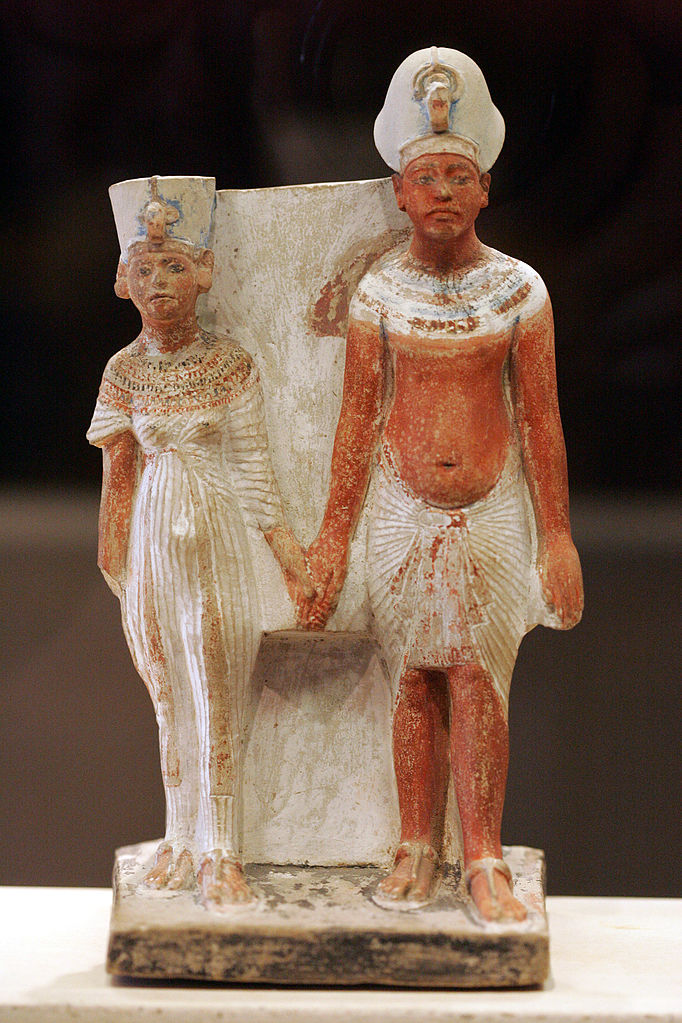
Akhenaten and Nefertiti.
By UnknownRama (RamaOwn work)
[CC-BY-SA-2.0-fr], via Wikimedia Commons
Sail the Nile like Cleopatra and Egyptian Queens.
Sail the Nile the way Nefertiti did it.
The Royal Dongola or the Zarafa Dahabiya.
Nefertiti Turns Egypt Upside Down!! 1350 BC – Queen Nefertiti is reported to have led her Egyptian subjects on a wild spree of idol-smashing, temple-destruction, and forced migration, all part of a campaign of religious reformation.
“From now on, there will be only one Deity, and that Deity is Aten, the Sun Disc,” she has commanded.
Reliable sources in the Nile Valley report that all temples to gods other than Aten have been closed, and that a hefty fine will be imposed on anyone caught with an outlawed statuette.
Idols are to be smashed immediately, and the shards turned over to the priests of Aten.
“The capital of Egypt will now be at Tel El Amarna,” reads a decree widely circulated in cuneiform on clay tablets.
“All priests are to settle within one hour’s journey of the new Temple to Aten. All bidders on public works contracts will likewise have their head offices within the same specified distance.”
Egyptian leaders in exile have disputed the motives behind the upheaval. “It’s just a ploy to concentrate power and wealth in her hands and those of her husband, Ikhnaton,” stated one defrocked priest.
“Everybody knows that Nefertiti has risen to her position on qualities that have nothing to do with religion.
She isn’t called Incarnation of Beauty for nothing,” he added, referring to the literal meaning of her name. The source asked not to be identified, fearing reprisals. Tel El Amarna, Nile Valley, 2004 – from Paul Glassman, special correspondent “Wow,” commented Joe Shiner, an agro-businesman from Des Moines, as he toured the main temple at Tel El Amarna. “It’s one thing to hear that Nefertiti was a real beauty. But it’s quite another to visit in person and learn the real story.” “Until I came here, I didn’t know that she was behind the idea of having only one god-even before the Hebrews and Christians and followers of Mohammed.
“And now that I see her picture, I can understand why people followed her. This is not what I expected . . . not at all!” Mr. Shiner gestured as he spoke to a temple painting of a well-endowed Nefertiti in a chariot, wearing only a see-through cloak and thong-style panties.
“If she was my queen, I’d follow her to the end of the . . . ”
Mr. Shiner’s comments were interrupted by the approach of his wife.
Disclaimer: The facts presented are as accurate as can be ascertained from the archeological record. Mr. Joe Shiner is a composite of the satisfied clients of Travel in Style.
Amarna is an extensive Egyptian archaeological site that represents the remains of the capital city newly established and built by the Pharaoh Akhenaten of the late Eighteenth Dynasty, and abandoned shortly after his death (1332 BC). The name for the city employed by the ancient Egyptians is written as Akhetaten in English transliteration. Akhetaten means “Horizon of the Aten”. – Wikipedia

AWIB-ISAW: Central City Amarna (IV). Mudbrick remains of the Central City area at Amarna and visible just beyond them are the large discard piles left behind by earlier archaeologists. © Kyera Giannini (2009)
The Armana Project is working with the agreement and co-operation of the Egyptian government, and in particular the Supreme Council of Antiquities. They seek to:
- Explore by archaeology the ancient city of Amarna and its historical context
- Preserve what is left of the ancient city
- Promote study and recording of the history, archaeology and traditional life and crafts of the surrounding region
- Increase public knowledge, at all levels, of the city of Amarna and of the surrounding region
 Loading