
The Egyptian Da Vinci
Suggested Readings
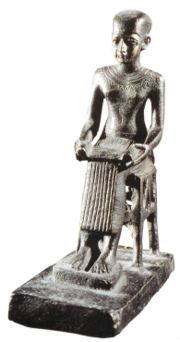
Imhotep (sometimes spelled Immutef, Im-hotep, or Ii-em-Hotep, meaning “the one who comes in peace”) was an Egyptian polymath, who served under the Third Dynasty king, Djoser, as chancellor to the pharaoh and high priest of the sun god Ra at Heliopolis. He is considered to be the first architect and physician known by name in history .
The full list of his titles is: Chancellor of the King of Lower Egypt, First after the King of Upper Egypt, Administrator of the Great Palace, Hereditary nobleman, High Priest of Heliopolis, Builder, Chief Carpenter, Chief Sculptor and Maker of Vases in Chief. As with Hatshepsut and Senemut’s later relationship, Imhotep is one of very few mortals to be depicted as part of a pharaoh’s statue. He was one of only a few commoners ever to be accorded divine status after death. The centre of his cult was Memphis. From the First Intermediate Period onward Imhotep was also revered as a poet and philosopher. His sayings were famously referred to in poems: I have heard the words of Imhotep and Hordedef with whose discourses men speak so much.
The knowledge of the location of Imhotep’s tomb was lost in antiquity and is still unknown, despite efforts to find it. The general consensus is that it is at Saqqara.
Much else ‘known’ about him is hear-say and conjecture. The ancient Egyptians credited him with many inventions. As one of the officials of the Pharaoh, Djosèr, he probably designed the Pyramid of Djoser (the Step Pyramid) at Saqqara in Egypt around 2630-2611 BC [5]. He may have been responsible for the first known use of columns in architecture. He has also been acclaimed to be the inventor of the Papyrus scroll, being its oldest known bearer.
Imhotep is credited with being the founder of Egyptian medicine and with being the author of a medical treatise remarkable for being devoid of magical thinking, the so-called Edwin Smith papyrus, detailing anatomical observations, ailments, and cures. The surviving papyrus was probably written around 1700 BC but may be a copy of texts a thousand years older. This attribution of authorship is speculative, however.
He was said to be a son of Ptah, his mother being a mortal named Khredu-ankh.
Two thousand years after his death, his status was raised to that of a deity. He became the god of medicine and healing. He later was linked to Asclepius by the Greeks. The Encyclopedia Britannica says, “The evidence aforded by Egyptian and Greek texts support the view that Imhotep’s reputation was very respected in early times… His prestige increased with the lapse of centuries and his temples in Greek times were the centers of medical teachings.”
As the “son of Ian”, his mother was sometimes said to be Sekhmet, the patron of Upper Egypt because Ptah often was said to have married her. As Imhotep was considered the inventor of healing, he was also sometimes said to be the one who held up the goddess Nut (the deification of the sky), as the separation of Nut and Geb (the deification of the earth) was said to be what held back chaos.
Due to the position this would have placed him in, he was also sometimes said to be Nut’s son. In artwork he also is linked with the great goddess, Hathor, who eventually became identified as the wife of Ra. He also was identified with Maat, the goddess who personified the concept of truth, cosmic order, and justice—having created order out of chaos and being responsible for maintaining it. An association with Amenhotep son of Hapu, who was another deified architect, also occurred.
It is Imhotep, says Sir William Osler, who was the real Father of Medicine. “The first figure of a physician to stand out clearly from the mists of antiquity.”
An inscription from Upper Egypt, dating from the Ptolemaic period, mentions a famine of seven years during the time of Imhotep. According to the inscription, the reigning pharaoh, Djoser, had a dream in which the Nile god spoke to him. Imhotep is credited with helping to solve the famine. The obvious parallels with the biblical story of Joseph have long been commented upon. [7]. More recently, the Joseph parallels have led some alternative historians to identify Imhotep with Joseph, and to argue that the supposedly thousand years separating them are indicative of a faulty chronology.
“I am probably standing on my grave,” he said. And he was.
Written by Raymond M. Wilkinson
Photographed by Nik Wheeler
About six months ago, Walter Emery, portly Englishman of nearly 68 years with a reputation as the world’s top Egyptologist, pulled a large trilby hat down on graying temples and pointed his cane at a shallow pit where workmen were scooping away sand from the entrance to a limestone passageway. “I am probably standing on my grave,” he said.
He was. On March 7, Walter Emery, after 48 years of “digging holes in Egypt,” collapsed on the site of that passageway—the passageway where he had expected to spend the rest of his life and which he was sure would one day lead him to the greatest discovery of his career: the tomb of Imhotep. Four days later he died, his search unfinished, the mystery of Imhotep unsolved.
Like the famous King Tut, whose tomb Howard Carter unearthed in Luxor in 1922, Imhotep—doctor, architect, philosopher, magician and politician—has long fascinated Egyptologists. He was surely one of the most intriguing figures of ancient Egypt. Although the books he is supposed to have written have vanished and there is no record of his private life, signs of his presence are everywhere, the most unmistakable being the small but unique Step Pyramid on the plateau of Sakkara, 20 miles from Cairo.
The Step Pyramid, the world’s oldest standing structure, is not impressive in either size or symmetry—the Great Pyramid at Giza is 250 feet higher—but in designing it, Imhotep introduced a new architectural form. To some sources that makes him the world’s first engineer. In Egypt it won him great honors and sonorous titles: “Chancellor of the King of Lower Egypt,” “Hereditary Prince,” “Greatest of Seers,” and “Ruler of the Great Estates.”
Curiously, Imhotep’s achievements as a physician, for which he is most widely known today, were not widely recognized until 2,000 years after his death. But then his name became so popular that Egyptians swarmed to his tomb seeking cures. Eventually they deified him as the God of Medicine. Even the Greeks and Romans, despite their own advances in medicine, granted him recognition. The Greeks identified him with their own God of Medicine, Eskalapies, and Cleopatra reportedly placed a dedication to him in the Temple of Philae.
Almost as quickly as it was revived, however, Imhotep’s reputation again disappeared under the sands of the desert—along with most traces of his accomplishments. It was not until 1920 that it was revived for the second time. That came about when Cecil Firth, a colleague of Emery’s, began to excavate a vast complex of subsidiary buildings around the Step Pyramid near Emery’s then-current dig. He discovered a statue apparently dedicated to the builder of the Step Pyramid and translated the name. It was Imhotep.
Excited by the discovery, Firth began to look for Imhotep’s tomb. He was convinced that it was within a few hundred yards of the Step Pyramid and searched there until his death in 1932.
Emery, in the meantime, had also been poking into the sands of Sakkara, a place he once called “one of the most fabulous treasure houses of man’s history.” Shortly after World War I he had made what he considered his major discovery: the tombs of the first dynasty of kings. After Firth’s death he took up the search for Imhotep, and despite other work in the Sudan and other parts of Egypt and World War II, kept at it intermittently until his collapse in March
Like Firth, Emery was sure that the tomb was near the Step Pyramid. In part his conviction was based on accounts written by Napoleon’s scientists when they first began to open up the wonders of Egypt in the early 19th century. At Sakkara these scientists had discovered what they called the “Tomb of the Birds,” and described how they “were lowered into pits which led to great passages covering vast areas full of birds.” Since the sacred bird of Imhotep was the ibis, and one of his titles was “The Great One of the Ibis,” Emery concluded that what the French had found was at least near Imhotep’s tomb. When he found another reference saying Imhotep was buried near the “Lake of the Crocodiles,” he conjectured that what is now a vast depression of sand in Sakkara was once a lake.
It was not until 1962, however, that Emery came across his first tangible clue: a huge trail of pottery fragments stretching hundreds of yards across the desert. Examination disclosed that they were fragments of vessels used in religious rites and that they dated back to the period when pilgrims began to approach Imhotep’s tomb. That, plus two old Royal Air Force photographs of the area, which showed the darker outline of ruined buildings two feet under the sand, convinced Emery that this was the place to dig, and dig he did.
The first discoveries, said Emery last winter, were very promising. “Almost immediately we found a Third Dynasty tomb. Then, going down into one of the burial shafts, we found around this tomb the bodies of sacrificial bulls, designating a sacred man.”
More significantly, they found a series of long underground galleries packed with mummified ibises, the sacred bird of Imhotep. There were more than a million of the birds, all packed in earthenware pots. Apparently, they had found the “Tomb of the Birds” referred to by Napoleon’s scientists.
Emery quickly pushed ahead, but ran into an unexpected difficulty: the sheer richness of the archeology. In Sakkara history is literally piled on top of itself. In places, the ruins of buildings from several dynasties were piled one on top of the other. Moreover, in uncovering one area, early explorers more often than not dumped the sand on an as yet undiscovered tomb nearby. For Emery that meant moving from his own 500-square-yard site thousands of additional tons of sand flung there by other scientists, and sometimes digging underneath ancient buildings.
It seemed hopeless at first but Emery, to the consternation of his colleagues, decided on a most unorthodox step. He brought in a bulldozer and in a few days cleared away what could have taken years. Some of his colleagues, he chuckled later, went into shock.
As the search for Imhotep continued, Emery found a series of passageways containing hundreds of mummified baboons, ancient Egypt’s symbol of wisdom and knowledge. In another he found mummified hawks. Shortly after that he found a small piece of stone in a wooden box deposited in a niche hewn into the rock wall of the hawks’ chamber. It was barely eight inches long but inscribed on it in ancient demotic text were the electrifying words: “Imhotep the Great. The son of Ptah the Great God and other Gods Who Rest Here.”
What did Emery hope to find? Treasure? Mummies? Emery was not sure, but he thought it unlikely. The grave robbers of the period would hardly have passed up the treasures that would have been put in Imhotep’s tomb. But the thieves, Emery hoped, might have left scrolls of papyrus, and the scrolls could well contain descriptions of medical practices, architectural designs, notes on everyday life. If so, he said once, it would be the greatest discovery since Carter groped into the tomb of King Tut. Asked if he thought he could be wrong about the location, Emery shook his head vehemently. “Imhotep is here,” he said, ” and I will find him.”
His faith may yet be justified. In Cairo, Geoffrey Martin, Emery’s longtime assistant, has announced that the search for Imhotep will go on.
You may wish to know that you can request a free copy of the issue of Saudi Aramco magazine in which you can find an incredible wealth of information on Egypt’s History, People etc., the Middle East, Arabs, Muslims and more, by writing to:
Special Requests
Saudi Aramco World
Box 2106
Houston, Texas 77252-2106
by faxing to 713-432-5536,
or by e-mailing EK.Catchings@AramcoServices.com
 Loading