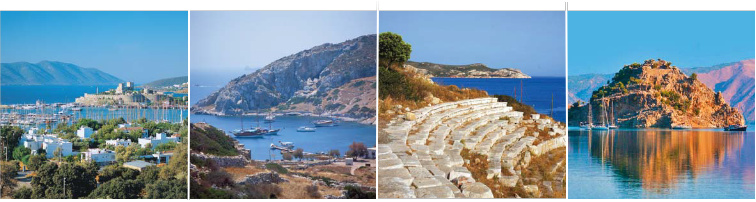
DEPARTING AND ENDING IN BODRUM
Day 1, Saturday. Transfer to the enchanting Bodrum harbor and board your luxurious sailing yacht in the afternoon. Your captain and crew will be waiting for you on board. (Transport from the airport is an additional charge.)
About the Gulet: Delight in the Aegean and eastern Mediterranean shores aboard this elegant sailing yacht, handcrafted of hardwoods mahogany and teak. Spacious fore, aft, and side decks, air-conditioning and advanced nautical equipment have been added to her ancient design to provide full modern comfort. The ingenious interior features luxurious living quarters with high ceilings and wide corridors. The spacious salon includes a stocked bar (nominal charges for drinks) and romantic cushioned seating area surrounding an elegant table. Mahogany walls aesthetically complement spacious cabins complete with queen beds, reading lights, generous storage space, air- conditioning, and private bathroom that includes a vanity with marble countertop and an enclosed shower.
A three- to five-person crew consisting of captain, cook, first mate, and deckhands take care of all needs of passengers and the yacht. The crew’s responsibilities include (among others) navigation and helm details, radio and telephone communications, ports-of-call details, raising sails when appropriate, cooking, cleaning, serving drinks and snacks throughout the day, and waiting on clients at meal times. From the fully equipped galley a skilled chef, whose expertise ranges from haute cuisine to regional specialties, guarantees satisfaction for even the most discriminating palate. Cuisine on board a gulet is imaginative and flavorful. Seafood is served Mediterranean style. Herbs, vegetables, and fruits of the season used on board are fresh and organically grown.
Sailing, waterskiing, windsurfing, snorkeling, canoeing, fishing, and board games or cards are just some of the extra activities available to passengers. Each day the captain will arrange visits ashore for hiking, site-seeing, shopping, dining, nightlife and, of course, the exploration of ancient sites. Clients should be prepared to spend the next seven days leisurely sailing, sunbathing, swimming, and shopping, all while exploring three thousand years of ancient history. Spend the first night on board in the Bodrum harbor or a nearby bay.
Day 2, Sunday. Depart Bodrum and sail across the Gulf of Gokova to the fascinating archeological site of Knidos, where the Aegean Sea and the Mediterranean meet.
(Optional): Tour the excavations of Knidos, famous in antiquity for the cult of Aphrodite begun here. Situated at the end of the peninsula, this Dorian city was built on terraces rising to an acropolis. Straddling the peninsula, the city had a harbor on either side and flourished during the Archaic, Classical, Hellenistic and Roman periods. Old Knidos was excavated in 1857 by C. T. Newton and, from 1967, by Iris Love. Famous as a center of art and culture in the fourth century BC, Knidos was established at the same time as Halikarnassos was, and it was one of the six Dorian colonies in Asia Minor. It seems to have retained a relatively pure Greek character, no doubt because it set its sights seaward and had little contact with the interior. Around 360 BC, Knidos was rebuilt at the windblown tip of the peninsula. The city banked on the fact that a good harbor at the outer edge of Asia Minor would become a popular port of call for ships on the Aegean-eastern Mediterranean sea routes. The rocky island facing the shore at the new site was joined to the mainland with a causeway, creating deep harbors on either side of the isthmus, one on the Aegean and the other on the Mediterranean. The island section comprised the residential quarters. A series of colonnaded walkways rose in terraced tiers on the land side. Two large theaters, an Odeon, and three temples completed what must have been a striking ensemble in the midst of a desolate, craggy site. The remains of a circular temple dedicated to the goddess of love, Aphrodite, overlook remains of the two harbours. The temple’s arcaded way was built of white-marble, heart-shaped columns. The legendary Aphrodite of Praxiteles’ famous statue, reputedly one of the most beautiful sculptures of antiquity, once graced this temple. Knidos was known as one of the most beautiful cities in ancient Greece.
In the early evening anchor near the idyllic Bay of Mesudiye.
(Optional): There is an outstanding restaurant here, the Ortam, which serves specialties like hot bread from their stone oven and stuffed calamari and octopus marinated in red wine and grilled to perfection.
Day 3, Monday. Sail into the Gulf of Hisaronu. The mountainous coastline and secluded rocky coves offer numerous anchorages. Stretching for 30 nautical miles into the Aegean Sea between the Greek Islands of Kos and Rhodes, this gulf is a sailing paradise because of its prevailing late morning winds, deep blue seas, and the backdrop of rugged mountains and small coastal villages.
Bencik Bay resembles a miniature fjord. The inlet, which extends inland about 1.5 nautical miles, is bounded by steep wooded slopes on either side. (Bencik is located at the narrowest part of the peninsula that divides the Hisaronu Gulf from the Gokova Gulf.)
Afterwards sail into the wide Bay of Selimiye, one of the most tranquil natural harbors in the Gulf of Hisarönü. Surrounded by magnificent scenery and largely unspoiled by modernity, Selimiye village gives the impression of having been frozen in time.
You have a chance to walk and observe in this village before cruising to Bozburun, a small, quiet fishing village. It was once the center of sponge diving along the Turkish coast, but nowadays locals here earn their living in a much less dangerous way – building broad-beamed wooden gulets.
Sail to the quiet Orhaniye Bay for the night. Behind the village of Orhaniye is an ancient acropolis. At its crown are the ruins of a medieval castle. The bay itself is known for its unique currents of sea-water known as “kiz mumu” (girl’s candle). The up-and-down swishing of the water has spawned numerous myths about a reddish sandy way or sea-road running from the shore to the mysterious interior of the sea. Anchor near the bay’s small island, where you can view the ruins of the castle and the spectacular watery expanses of the bay.
(Optional): There is an excellent restaurant in the village of Orhaniye named Club Mistral, which serves delicious starters using organic vegetables and herbs from their own garden.
Day 4, Tuesday. Depart for the Bay of Bozukkale, which means “ruined castle,” a reference to the fact that one side of the ancient castle here is missing. The entrance to the bay is guarded by this castle, 350 meters long and 30 meters wide and dating back to 430 BC. When you arrive in the bay, you can clearly see the ruins of the ancient harbor. In ancient times this site was known as the city of Loryma. Throughout history, because of its isolated location, the site was used chiefly for refuge rather than trade. Occasionally, however, it was also used to assemble naval fleets. The Athenian fleet assembled in Loryma during the Peloponnesian War around 400 BC. In 305 BC Demetrios Poliorcretes of Macedonia assembled his battle fleet of 200 ships and 150 auxiliary vessels here in an attempt to take the city of Rhodes. Despite his large force, he had to give up his campaign. In 304 BC he signed a peace agreement, leaving behind a huge store of military equipment in Rhodes. The Rhodians sold this equipment and used the proceeds to erect a magnificent statue dedicated to their sun god, Helios. To the modern world this statue is known as the Colossus of Rhodes, one of the seven wonders of the ancient world. The Colossus was later destroyed by a powerful earthquake. Hike up to the ruins for some spectacular views of the Greek Islands of Simi and Rhodes.
The crosswinds in this region are excellent for sailing. Cruise north to Ciftlik Bay, a hidden cove with a small sandy beach half way up the Datca peninsula.
Day 5, Wednesday. In the early morning set sail to picturesque resort of Datça. Although this town offers limited shopping and café possibilities, it is an excellent place for a brief walk and observations. Known for its natural beauty and climate, Datca provides a window on the life of rural Turkey 50 to 100 years ago. Village life is still based on agriculture, fishing, and the building of the gulet (the traditional 2-masted Turkish wooden sailing vessel). Pine, oak, and myrtle abound on the mountain slopes plunging down to a pleasant beach and two natural harbors.
Set sail for the tiny Greek Island of Simi, which hugs the Turkish coast in the Strait of Marmaris. The scenic natural landscape consists of rugged coastline with sheer cliffs, narrow fjords, private coves, and high mountains. Since classical times, Simi has flourished due to the success of it sponge-diving and boat-building industries. It launched up to 500 ships a year. Indeed, it became the third richest island of the Dodecanese. The island’s well protected natural harbors prompted the Italians to occupy it at the beginning of the 20th century. German occupation followed in World War II. After these occupations, Simi never recovered economically, and the mansions built in better times slowly crumbled. Today, elaborate churches, elegant boutiques, seafood restaurants, and cafés line the fairy-tale-like harbor painted in numerous shades of pastel colors. Simi is notably different from other Dodecanese islands, retaining its many signs of refinement and aristocratic charm. These are noticeable both in the carefully restored neo-classical homes and in the gracious hospitality of the island’s inhabitants. Dock in the exquisitely beautiful city harbor in the early evening.
Day 6, Thursday. Depart from the Simi harbor and cruise to the island’s western side to take in the sweeping, peaceful view of the Panormitis Monastery of the Archangel Michael. Among its features are its Byzantine frescos. Enjoy a swim break in the Bay of St. George before returning to the Turkish coastline.
Cruise to Palamut Bükü, the most western anchorage in the Gulf of Hisaronu. It is well known for its sparkling and pristine sea, fresh fish, and delicious, large, locally grown almonds.
Afterwards sail to Mersincik, located in the Gulf of Gokova. Mersincik is bordered by high mountains and woods. Its clear waters and seclusion make it a favorite spot for spending the night.
Day 7, Friday. This morning cross the Gulf of Gokova to the Bay of Kesibükü and its pine-clad shores. Take advantage of the calm morning hours to sail in the quiet waters along the coast. Stop over at Karaada Island. Late in the afternoon enter the Bodrum harbor or continue to the attractive bay of Ada Bogazi for night.
Year round balmy temperatures, international marinas, elegant boutiques, chic cafés and night clubs, and a variety of delightful dining experiences attract many to the lively Bodrum harbor. The 15th-century Crusader castle, the Museum of Underwater Archaeology, and the Mausoleum of Halikarnassos, one of Seven Wonders of the Ancient World, add an important historical dimension to this resort city.
(Optional): Karaada Island is noted for its thermal features and mud baths. Enjoy a hike around the island and swim in the comfortably warm thermal sulfur baths.
(Optional): This afternoon visit the 15th-century Crusader castle, which houses the Bodrum Museum of Underwater Archaeology. Exhibits ancient shipwrecks raised off the coast of Turkey and the intact remains of a Carian princess’ tomb dating back to the time of Alexander the Great.
Day 8, Saturday. Depart after breakfast for the Bodrum airport to fly back to Istanbul or transfer to your next destination. (Transport to the airport or your next destination is an additional charge.)
*Greek Island harbor fees are extra.
*Where entrance fees or the service of a guide/or van are required, the charges are extra.
*Optional restaurant meals off the yacht are not included in the price, but meals off board will be deducted from the catering fees. Restaurants onshore require reservations.
 Loading