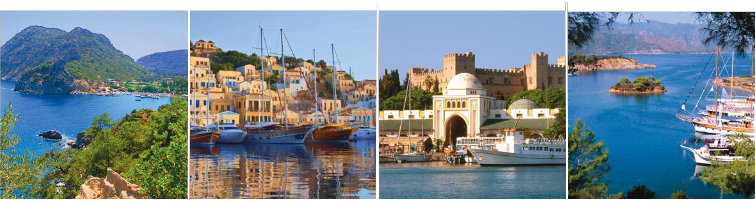
DEPARTING IN BODRUM AND ENDING IN GOCEK
Day 1, Saturday. Transfer to the enchanting Bodrum harbor and board your luxurious sailing yacht in the afternoon. Your captain and crew will be waiting for you on board. (Transport from the airport is an additional charge.)
About the Gulet: Delight in the Aegean and eastern Mediterranean shores aboard this elegant sailing yacht, handcrafted of hardwoods mahogany and teak. Spacious fore, aft, and side decks, air-conditioning and advanced nautical equipment have been added to her ancient design to provide full modern comfort. The ingenious interior features luxurious living quarters with high ceilings and wide corridors. The spacious salon includes a stocked bar (nominal charges for drinks) and romantic cushioned seating area surrounding an elegant table. Mahogany walls aesthetically complement spacious cabins complete with queen beds, reading lights, generous storage space, air- conditioning, and private bathroom that includes a vanity with marble countertop and an enclosed shower.
A three- to five-person crew consisting of captain, cook, first mate, and deckhands take care of all needs of passengers and the yacht. The crew’s responsibilities include (among others) navigation and helm details, radio and telephone communications, ports-of-call details, raising sails when appropriate, cooking, cleaning, serving drinks and snacks throughout the day, and waiting on clients at meal times. From the fully equipped galley a skilled chef, whose expertise ranges from haute cuisine to regional specialties, guarantees satisfaction for even the most discriminating palate. Cuisine on board a gulet is imaginative and flavorful. Seafood is served Mediterranean style. Herbs, vegetables, and fruits of the season used on board are fresh and organically grown.
Sailing, waterskiing, windsurfing, snorkeling, canoeing, fishing, and board games or cards are just some of the extra activities available to passengers. Each day the captain will arrange visits ashore for hiking, site-seeing, shopping, dining, nightlife and, of course, the exploration of ancient sites. Clients should be prepared to spend the next seven days leisurely sailing, sunbathing, swimming, and shopping, all while exploring three thousand years of ancient history. The first night is spent on board in the Bodrum harbor or nearby bay or cove.
Day 2, Sunday. Year round balmy temperatures, international marinas, elegant boutiques, chic cafés and night clubs, and a variety of delightful dining experiences attract many to the lively Bodrum harbor. The 15th-century Crusader castle, the renowned Museum of Underwater Archaeology, and the Mausoleum of Halikarnassos, one of Seven Wonders of the Ancient World, add an important historical dimension to this resort city.
(Optional): This morning visit the 15th-century Crusader castle, which houses the Bodrum Museum of Underwater Archaeology. Museum exhibits include ancient shipwrecks raised off the coast of Turkey and the intact remains of a Carian princess’ tomb dating back to the time of Alexander the Great.
Depart from Bodrum, sailing across the Gulf of Gokova to the beautiful archeological site of Knidos, where the Aegean Sea meets the Mediterranean.
(Optional): Tour the excavations of Knidos, famous in antiquity for the cult of Aphrodite begun here. Situated at the end of the peninsula, this Dorian city was built on terraces rising to an acropolis. Straddling the peninsula, the city had a harbor on either side and flourished during the Archaic, Classical, Hellenistic and Roman periods. Old Knidos was excavated in 1857 by C. T. Newton and, from 1967, by Iris Love. Famous as a center of art and culture in the fourth century BC, Knidos was established at the same time as Halikarnassos was, and it was one of the six Dorian colonies in Asia Minor. It seems to have retained a relatively pure Greek character, no doubt because it set its sights seaward and had little contact with the interior. Around 360 BC, Knidos was rebuilt at the windblown tip of the peninsula. The city banked on the fact that a good harbor at the outer edge of Asia Minor would become a popular port of call for ships on the Aegean-eastern Mediterranean sea routes. The rocky island facing the shore at the new site was joined to the mainland with a causeway, creating deep harbors on either side of the isthmus, one on the Aegean and the other on the Mediterranean. The island section comprised the residential quarters. A series of colonnaded walkways rose in terraced tiers on the land side. Two large theaters, an Odeon, and three temples completed what must have been a striking ensemble in the midst of a desolate, craggy site. The remains of a circular temple dedicated to the goddess of love, Aphrodite, overlook remains of the two harbours. The temple’s arcaded way was built of white-marble, heart-shaped columns. The legendary Aphrodite of Praxiteles’ famous statue, reputedly one of the most beautiful sculptures of antiquity, once graced this temple. Knidos was known as one of the most beautiful cities in ancient Greece.
Day 3, Monday. In the early morning cruise to the picturesque resort of Datca. Enjoy a brief stroll through the town, which offers limited shopping and café possibilities. Known for its natural beauty and pleasant climate, Datca provides a window on the life of rural Turkey some 50 to 100 years ago. Village life is still based on agriculture, fishing, and the building of gulets (traditional two-masted Turkish wooden sailing vessels). Mountains abounding in pine, oak, and myrtle plunge down to a sand beach and two natural harbors.
Set sail for the tiny Greek Island of Simi, which hugs the Turkish coast in the Straights of Marmaris. The scenic natural landscape consists of jagged coastline with sheer cliffs, narrow fjords, private coves, and high mountains. Since classical times, Simi has flourished due to the success of it sponge-diving and boat-building industries. It launched up to 500 ships a year. Indeed, it became the third richest island of the Dodecanese. The island’s well protected natural harbors prompted the Italians to occupy it at the beginning of the 20th century. German occupation followed in World War II. After these occupations, Simi never recovered economically, and the mansions built in better times slowly crumbled. Today, elaborate churches, elegant boutiques, seafood restaurants, and cafés line the fairy-tale-like harbor painted in numerous shades of pastel colors. Simi is notably different from other Dodecanese islands, retaining its many signs of refinement and aristocratic charm. These are noticeable both in the carefully restored neo-classical homes and in the gracious hospitality of the island’s inhabitants. The opposite (western) side of the island is the peaceful setting of the Panormitis Monastery of the Archangel Michael with its impressive Byzantine frescos. Enjoy a swim in the Bay of St. George. Then sail back to the stunning, storybook harbor of the city of Simi.
Day 4, Tuesday. Set sail for the nearby Greek island of Rhodes. From the boat’s marina moorage it is possible to spend the day independently in Rhodes exploring the narrow streets, shops, galleries, cafes, gardens, and ruins of the medieval old city.
(Optional): A privately guided morning exploration of the Island of Rhodes, the capital and largest island of the Dodecanese. The famous Colossus of Rhodes was one of the Seven Wonders of the Ancient World. The perfectly intact medieval old town was restored by the Italians during their occupation in the 1930s. Four kilometers of medieval city walls encircle narrow cobble-stoned lanes leading to the street of the Knights and the magnificent Grand Masters Palace. Today this palace houses an extensive archaeological museum and Roman mosaics transported from the Greek Island of Kos. The Mandraki harbor is the hub of life and the link between the old and new towns. The new city, in contrast to the old, has wide streets, modern cafés, and upscale boutiques.
(Optional): If you wish to visit other parts of the island with a van in the afternoon, you have two choices:
A tour of the lesser known sites of the island of Rhodes. Drive 30 minutes to the small harbor at Skala Kamiros, full of traditional fish restaurants. On the ancient site of Kamiros stood one of the three powerful cities of Rhodes in ancient times. Rediscovered in 1929, it has been called the Greek Pompei because nobody can explain why and how the city was deserted and buried.
This island drive also runs through the laregely agricultural interior of the island, which and has spectacular views, small villages, old monasteries, and forests.
Or
The more typical tour. Enjoy lunch at a local restaurant and then get back into the van and continue with a one-hours drive to the site of Lindos. To see the remains of ancient Lindos requires a sturdy climb to the acropolis, which offers a breathtaking view of the Mediterranean. The hospitable whitewashed village of Lindos, with its winding alleyways, old houses with red-tiled roofs, and a lovely Byzantine church, lies at the foot of the acropolis, Nearby island cliffs were used as setting for filming a major part of “The Guns of Navarone.”
Day 5, Wednesday. Return to the Turkish coast, docking in the lively and attractive resort city of Marmaris. Once a little fishing port, Marmaris is now often referred to as “The Jewel of the Turkish Riviera.” Surrounded by pine- covered hills, this cosmopolitan city hugs one of the world’s largest and most beautiful natural harbors where the Aegean Sea meets the Mediterranean. The old town, with its castle, historically preserved homes, and bustling bazaars, is a tourist’s delight. Shopping opportunities are many here. In the early evening set sail for a secluded cove outside of the Marmaris Bay for night anchorage.
Day 6, Thursday. Cruise to the remote Bay of Ekincik to visit Dalyan, a fishing village located on the Calbis River. The sandy Istuzu Beach is now the last breeding ground for the pre-historic Loggerhead turtle.
(Optional): A trip by fishing boat takes you past the remarkable river scenery, once the setting for the classic film “The African Queen,” to the awe-inspiring cliff tombs and ancient city of the Caunians. One of the most stunning features of the tomb site is rock tombs sculpted in the form of the porticoes of small Ionian temples. These are among the most splendid examples of Lycian funerary architecture in Turkey, although the tomb builders were Carians. The identity of the original occupants of the tombs is unclear, but they are assumed to have been Caunian noblemen and rulers. In most cases the tombs were vacated and reused in Roman times. The largest one is unfinished, thus providing a fascinating glimpse into the method of construction. The prosperity of Caunos was threatened by the silting of the harbor, after the silting the city was eventually abandoned. The Mediterranean shore, which once surrounded the hill on which the archaeological site stands, has now retreated 5 kilometers to the south, pushed back by silt from the Dalyan River. The marsh that subsequently formed appears to have been a problem for harbor activities already in the time of historian Strabon.
The border between the sea and the internal marsh is a long narrow sand bar called “the Turtle’s Beach.” This beach is one of the few remaining locations in the Mediterranean Sea that has the right conditions for the Giant Loggerhead Turtle (Caretta Caretta) to reproduce. Loggerheads have used this beach for reproduction since time immemorial. Eggs are laid principally in June. The females lay their eggs by night in the soft sand in clutches of about 100. Since the early 1990s the beach has been closed to the public from 8 pm to 8 am to protect the turtles. The beach is open during the day, but swimmers and sunbathers are asked to exercise special care.
Day 7, Friday. This day is devoted to enjoying the lovely bays around Gocek. The day concludes with sailing, swimming and snorkeling.
(Optional): Drop anchor late near Kizil Island. At the island’s pinnacle is a beautiful restaurant called the Lighthouse. Getting there before sunset is a good idea in order to explore the gardens in daylight.
Dock in the picturesque port of Gocek. Gocek is a small seaside farming village that has been transformed into the premier yachting center of Turkey. It lies in a valley surrounded by hills on three sides. Due to abundant freshwater, warm climate and very fertile deltaic soil, farming continues here. Just two blocks from the seaside promenade, houses still have their little gardens where residents grow many kinds vegetables, from tomatoes to eggplants. The seaside walkways are corridors of orange, tangerine, grapefruit, and lemon trees. The city’s green panorama is further accented by the ever-present pine trees in the nearby hills.
Day 8, Saturday. Depart after breakfast for the Dalaman airport and a flight back to Istanbul or for a transfer to your next destination. (Transport to the airport or transfer to another destination will be charged additionally.)
*Greek Island harbor fees are extra.
*Where entrance fees or the service of a guide and/or van are required in optional touring, the charges for these are extra.
*Optional restauranting on land is not included in the price, but meals off-board will be deducted from the on-board catering fees. Restaurants on shore require reservations.
 Loading