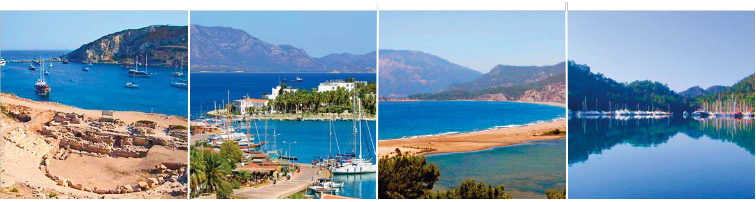
DEPARTING FROM BODRUM AND ENDING IN GOCEK
Day 1, Saturday. Transfer to the enchanting Bodrum harbor and board your luxurious sailing yacht in the afternoon. Your captain and crew will be waiting for you on board. (Transport from the airport is an additional charge.)
About the Gulet: Delight in the Aegean and eastern Mediterranean shores aboard this elegant sailing yacht, handcrafted of hardwoods mahogany and teak. Spacious fore, aft, and side decks, air-conditioning and advanced nautical equipment have been added to her ancient design to provide full modern comfort. The ingenious interior features luxurious living quarters with high ceilings and wide corridors. The spacious salon includes a stocked bar (nominal charges for drinks) and romantic cushioned seating area surrounding an elegant table. Mahogany walls aesthetically complement spacious cabins complete with queen beds, reading lights, generous storage space, air- conditioning, and private bathroom that includes a vanity with marble countertop and an enclosed shower.
A three- to five-person crew consisting of captain, cook, first mate, and deckhands take care of all needs of passengers and the yacht. The crew’s responsibilities include (among others) navigation and helm details, radio and telephone communications, ports-of-call details, raising sails when appropriate, cooking, cleaning, serving drinks and snacks throughout the day, and waiting on clients at meal times. From the fully equipped galley a skilled chef, whose expertise ranges from haute cuisine to regional specialties, guarantees satisfaction for even the most discriminating palate. Cuisine on board a gulet is imaginative and flavorful. Seafood is served Mediterranean style. Herbs, vegetables, and fruits of the season used on board are fresh and organically grown.
Sailing, waterskiing, windsurfing, snorkeling, canoeing, fishing, and board games or cards are just some of the extra activities available to passengers. Each day the captain will arrange visits ashore for hiking, site-seeing, shopping, dining, nightlife and, of course, the exploration of ancient sites. Clients should be prepared to spend the next seven days leisurely sailing, sunbathing, swimming, and shopping, all while exploring three thousand years of ancient history. Spend the first night on board in the Bodrum harbor or a nearby bay.
Day 2, Sunday. Year round balmy temperatures, international marinas, elegant boutiques, chic cafés and night clubs, and a variety of delightful dining experiences attract many to the lively Bodrum harbor. The 15th-century Crusader castle, the Museum of Underwater Archaeology, and the Mausoleum of Halikarnassos, one of Seven Wonders of the Ancient World, add an important historical dimension to this resort city.
(Optional): This morning visit the 15th-century Crusader castle, which houses the Bodrum Museum of Underwater Archaeolog. Exhibits in the museum include ancient shipwrecks raised off the coast of Turkey and the intact remains of a Carian princess’ tomb dating back to the time of Alexander the Great.
Depart from Bodrum, sailing across the Gulf of Gokova to the marvelous archeological site of Knidos, where the Aegean Sea and the Mediterranean meet.
(Optional): Tour the excavations of Knidos, famous in antiquity for the cult of Aphrodite begun here. Situated at the end of the peninsula, this Dorian city was built on terraces rising to an acropolis. Straddling the peninsula, the city had a harbor on either side and flourished during the Archaic, Classical, Hellenistic and Roman periods. Old Knidos was excavated in 1857 by C. T. Newton and, from 1967, by Iris Love. Famous as a center of art and culture in the fourth century BC, Knidos was established at the same time as Halikarnassos was, and it was one of the six Dorian colonies in Asia Minor. It seems to have retained a relatively pure Greek character, no doubt because it set its sights seaward and had little contact with the interior. Around 360 BC, Knidos was rebuilt at the windblown tip of the peninsula. The city banked on the fact that a good harbor at the outer edge of Asia Minor would become a popular port of call for ships on the Aegean-eastern Mediterranean sea routes. The rocky island facing the shore at the new site was joined to the mainland with a causeway, creating deep harbors on either side of the isthmus, one on the Aegean and the other on the Mediterranean. The island section comprised the residential quarters. A series of colonnaded walkways rose in terraced tiers on the land side. Two large theaters, an Odeon, and three temples completed what must have been a striking ensemble in the midst of a desolate, craggy site. The remains of a circular temple dedicated to the goddess of love, Aphrodite, overlook remains of the two harbours. The temple’s arcaded way was built of white-marble, heart-shaped columns. The legendary Aphrodite of Praxiteles’ famous statue, reputedly one of the most beautiful sculptures of antiquity, once graced this temple. Knidos was known as one of the most beautiful cities in ancient Greece.
This evening drop anchor near the idyllic Bay of Mesudiye.
(Optional): There is an excellent restaurant here, the Ortam, which serves specialties like hot bread from their stone oven and stuffed calamari and octopus marinated in red wine and grilled to perfection.
Day 3, Monday. Early morning set sail to picturesque resort of Datça. Although this town offers limited shopping and café possibilities, it is an excellent place for a brief walk and observations. Known for its natural beauty and climate, Datca provides a window on the life of rural Turkey 50 to 100 years ago. Village life is still based on agriculture, fishing, and the building of the gulet (the traditional 2-masted Turkish wooden sailing vessel). Pine, oak, and myrtle abound on the mountain slopes plunging down to a pleasant beach and two natural harbors.
Sail into the Gulf of Hisaronu. The mountainous coastline and secluded rocky coves offer numerous anchorages. Stretching for 30 nautical miles into the Aegean Sea between the Greek Islands of Kos and Rhodes, this gulf is sailing paradise because of its prevailing late morning winds, deep blue seas, and the backdrop of rugged mountains and small coastal villages.
Bencik Bay resembles a miniature fjord. The inlet, which extends inland about 1.5 nautical miles, is bounded by steep wooded slopes on either side. (Bencik is located at the narrowest part of the peninsula that divides the Hisaronu Gulf from the Gokova Gulf.)
Afterwards sail into the wide Bay of Selimiye, one of the safest natural harbors in the Gulf of Hisarönü. Surrounded by magnificent scenery and largely unspoiled by modernity, Selimiye village gives the impression of having been frozen in time.
You have a chance to walk and observe in this village before cruising to Bozburun, a small, quiet fishing village. It was once the center of sponge diving along the Turkish coast, but nowadays locals here earn their living in a much less dangerous way – building broad-beamed wooden gulets.
Sail to the quiet Orhaniye Bay for the night. Behind the village of Orhaniye is an ancient acropolis. At its crown are the ruins of a medieval castle. The bay itself is known for its unique currents of sea-water known as “kiz mumu” (girl’s candle). The up-and-down swishing of the water has spawned numerous myths about a reddish sandy way or sea-road running from the shore to the mysterious interior of the sea. Anchor near the bay’s small island, where you can view the ruins of the castle and the spectacular watery expanses of the bay.
(Optional): An exceptional restaurant called Club Mistral is located by the sea shore in the village of Orhaniye.
Day 4, Tuesday. Depart for the Bay of Bozukkale, which means “ruined castle,” a reference to the fact that one side of the ancient castle here is missing. The entrance to the bay is guarded by this castle, 350 meters long and 30 meters wide and dating back to 430 BC. When you arrive in the bay, you can clearly see the ruins of the ancient harbor. In ancient times this site was known as the city of Loryma. Throughout history, because of its isolated location, the site was used chiefly for refuge rather than trade. Occasionally, however, it was also used to assemble naval fleets. The Athenian fleet assembled in Loryma during the Peloponnesian War around 400 BC. In 305 BC Demetrios Poliorcretes of Macedonia assembled his battle fleet of 200 ships and 150 auxiliary vessels here in an attempt to take the city of Rhodes. Despite his large force, he had to give up his campaign. In 304 BC he signed a peace agreement, leaving behind a huge store of military equipment in Rhodes. The Rhodians sold this equipment and used the proceeds to erect a magnificent statue dedicated to their sun god, Helios. To the modern world this statue is known as the Colossus of Rhodes, one of the seven wonders of the ancient world. The Colossus was later destroyed by a powerful earthquake. Loryma is mentioned in the writings of Byzantine Emperor Constantine Porphyrogenitos as an arsenal, and until recently it was known as opsolika (arsenal bay). Hike up to the ruins for some spectacular views of the Greek Islands of Simi and Rhodes. Afterwards cruise to the Bay of Serce, two miles south of Bozukkale. The entrance to the Serce harbor resembles a giant door made of enormous boulders. The western side of the harbor consists of steep slopes and rough, rocky terrain.
Day 5, Wednesday. Cruise to the remote Bay of Ekincik to visit Dalyan, a fishing village located on the Calbis River. The sandy Istuzu Beach is now the last breeding ground for the pre-historic Loggerhead turtle.
(Optional): A trip by fishing boat takes you past the remarkable river scenery, once the setting for the classic film “The African Queen,” to the awe-inspiring cliff tombs and ancient city of the Caunians. One of the most stunning features of the tomb site is rock tombs sculpted in the form of the porticoes of small Ionian temples. These are among the most splendid examples of Lycian funerary architecture in Turkey, although the tomb builders were Carians. The identity of the original occupants of the tombs is unclear, but they are assumed to have been Caunian noblemen and rulers. In most cases the tombs were vacated and reused in Roman times. The largest one is unfinished, thus providing a fascinating glimpse into the method of construction. The prosperity of Caunos was threatened by the silting of the harbor, after the silting the city was eventually abandoned. The Mediterranean shore, which once surrounded the hill on which the archaeological site stands, has now retreated 5 kilometers to the south, pushed back by silt from the Dalyan River. The marsh that subsequently formed appears to have been a problem for harbor activities already in the time of historian Strabon.
The border between the sea and the internal marsh is a long narrow sand bar called “the Turtle’s Beach.” This beach is one of the few remaining locations in the Mediterranean Sea that has the right conditions for the Giant Loggerhead Turtle (Caretta Caretta) to reproduce. Loggerheads have used this beach for reproduction since time immemorial. Eggs are laid principally in June. The females lay their eggs by night in the soft sand in clutches of about 100. Since the early 1990s the beach has been closed to the public from 8 pm to 8 am to protect the turtles. The beach is open during the day, but swimmers and sunbathers are asked to exercise special care.
Day 6, Thursday. Sail early morning to the Bay of Agia Liman, the site of ancient Lydae. An uphill hike leads you to an awesome panoramic view and to Byzantine ruins. Afterwards sail south to Olu Deniz, the “Sea of the Dead,” Turkey’s most photographed lagoon. Sail to a bay near Gemiler Island and visit the island an hour before sundown. The sunsets here are incredible.
Ancient Lydae, off the beaten path and thus rarely visited, requires a thirty-minute uphill hike. Lydae features, among other intriguing sights, tombs, a basilica, protective walls, cisterns, sections of Corinthian columns, inscribed pedestals from the Roman and Byzantine periods, and a vaulted Carian rock tomb in two levels. The tomb dates from the 5th or 4th century BC. In 46 BC the Egyptian Queen Cleopatra visited the Bay of Agia Liman at age 23, beaching her galleys to rest her oarsmen while en route to Rome to plead Egypt’s case before the Senate. The bay has two beaches, one that is shaded from the sun and rich with flowers and one from which the ancient road runs upward to Lydae.
Olu Deniz, with its stunning blue lagoon, is regarded as the most picturesque beach in Turkey. Thus the water is the main attraction here, particularly for paragliders who come from all over the world to glide over the turquoise waters from atop the Babadag Mountain. Photographs of the crystalline blue lagoon and its photogenic grey-white beach adorn almost every Turkish travel brochure. Olu Deniz is now in a conservation area, and new development is strictly controlled. There is a small entry fee to the lagoon beach itself, which is well suited for children and has shaded areas, cafés, and showers. On the other side of the sandbar, Belçekiz beach presents a crescent-shaped stretch of pebbles and sand with a backdrop of splendid pine-clad mountains. Olu Deniz literally means “Sea of the Dead.” The origin of its name is attributed to the following legend: once upon a time a father and son, out on a fishing trip, were caught in a powerful storm. They were in mortal danger of sinking. The son claimed that if they approached the rocks on shore, they could take shelter in a cove he knew of. The father, however, convinced that there were no coves nearby, insisted that their boat would be flung onto the rocks and destroyed by the pounding surf, and they would both die. In his terror, the father knocked his son (who was at the helm) into the sea with an oar and took over the helm himself. Just as the boat was about to hit the rocks of the cape, the water around him turned into a peaceful, calm bay. The son had drowned in the stormy waters, however, and thus the cove was named Sea of the Dead.
(Optional): Gemiler Island is covered with Lycian ruins, including a covered walkway built for a princess who (according to legends) was regarded by her father as either too beautiful to be seen by the populace, or albino and so in need of protection from the sunlight, or just very spoiled. Other features include an ancient palace that contains some of its mosaics, several Byzantine churches, and the remains of a harbor later used (according to legend) by pirates.
Day 7, Friday. In there morning you can opt to visit Kayakoy, and in the afternoon you many wish to enjoy the lovely bays around Gocek. There is time enough for sailing, swimming, and snorkeling.
(Optional): Another opportunity is a rigorous one-hour hike or, for those who prefer driving, a 10-minute mini-bus ride from the Gemiler dock to the deserted Greek village of Kayakoy. One should wear good walking shoes, even if taking the mini-bus, because in the deserted village one walks marble streets.
(Optional): There is an excellent and attractive restaurant in Kayaköy, the Sarnic Restaurant, where one can lunch. The restaurant is a fully restored deserted home (see below) that has also been turned into an ethnological museum. The restaurant serves its specialties in a beautiful, shaded courtyard.
The captivating Ghost Village of Kayakoy, six kilometers from the Gemiler pier, was evacuated during the Turkish- Greek population exchange of 1922. The history of Kayakoy dates back to 3000 BC philologically. The oldest remains, however, are a few sarcophagi and rock tombs from the 4th century BC. The buildings on the slopes belonged to Greeks who had settled here under provisions extended to minorities by the Ottoman Empire during the second half of the 19th century and the early 20th century. During the early years of the Turkish Republic, the Greek residents in this region were exchanged with Turks living in Western Thrace. But the re-population failed here. In time, wooden panels in doors, windows and the roofs fell victim to natural dereliction and ruin and the city acquired a ghost-like appearance. The 350-400 houses of this deserted city, each a maximum size of 50 square meters, had been built according to a plan that allowed for panoramic view and light fusion. The ground floor was usually used for storage purposes, and there were underground water cisterns to collect the rain from the rooftops. Scattered among the houses were many chapels, a school building, and a customs office.
Return to the yacht and sail into the Gocek Bay.
(Optional): Drop anchor late near Kizil Island. At the top of the island is a beautiful restaurant called the Lighthouse. You should arrive there before sunset so as to have the opportunity to view the gardens in daylight.
After dinner, dock in the picturesque port of Gocek. Gocek is a small seaside farming village that has been transformed into the premier yachting center of Turkey. It lies in a valley surrounded by hills on three sides. Due to abundant freshwater, warm climate and very fertile deltaic soil, farming continues here. Just two blocks from the seaside promenade, houses still have their little gardens where residents grow many kinds vegetables, from tomatoes to eggplants. The seaside walkways are corridors of orange, tangerine, grapefruit, and lemon trees. The city’s green panorama is further accented by the ever-present pine trees in the nearby hills.
Day 8, Saturday. Depart after breakfast for the Dalaman airport to fly back to Istanbul or transfer to your next destination. (Transport to the airport or other destination is an additional charge.)
*Where entrance fees are required or the service of a guide and /or van are needed in optional touring, the charges are extra.
*Optional restaurant meals off the yacht are not included in the price, but such meals off board will be deducted from the catering fees. Restaurants on-shore require reservations.
 Loading