in Egypt’s Western Desert
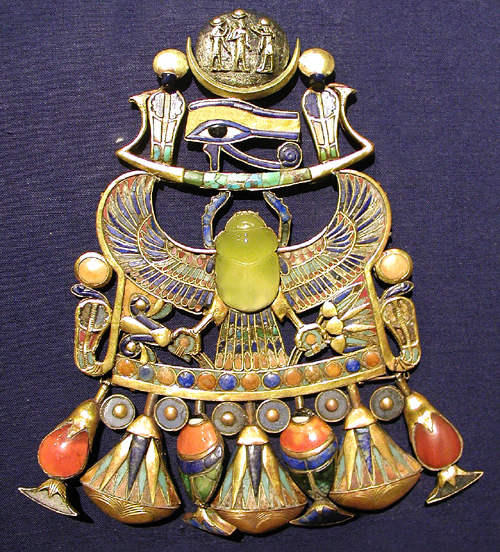
Tutanhkamun pendant with Wadjet
By Jon Bodsworth [see page for license], via Wikimedia Commons
It’s back to ancient days as we follow the pilgrimage route of Alexander the Great to the Oracle of Amon. He marched westward along the Mediterranean coast, then inland (south) to the great oasis of Siwa. His aim was to visit the great temple of Amun which, tradition says, his legendary “ancestors” Heracles and Perseus had visited. He entered the temple and was hailed by the priests as pharaoh, the son of Amun. He then had a private audience with the High Priestess of the oracle, who proclaimed him to be a god, the son of Zeus. She predicted that he would conquer vast territories. He did. Leaving Egypt, he marched into Persia conquering all who came before him, all the way to what is now Lahore in Pakistan.
On his return trip, however, he fell ill and died at the ripe age of 33 in Babylon. According to ancient inscriptions, Alexander’s body was returned to Egypt and buried but where?
Both Siwa and Alexandria are possibilities. His tomb has not yet been identified for sure. At Gebel Mawta, we’ll see tombs of the Greco-Roman era, including one that’s reputed to be Alexander’s own tomb. At Siwa, we’ll see an ancient fortress with winding alleyways, and the Temple of Amon, where Alexander’s divinity and legitimacy were proclaimed. Within a short distance, we’ll traverse centuries as we visit Cleopatra’s Pool, a Roman outpost, and a Ptolemaic temple.
Egypt Grand Sahara Adventure (14 days)
The Egyptian Oasis (16 days)
An Egyptian Oasis Adventure (21 days)
The Egyptian Oases
Adrère Amellal
The Egyptian Western Sahara
Tips on Camping in the Egyptian Desert
A note about meals served
Please note that some meals will be served in local desert style. For your Egyptian breakfast expect orange juice, tea and coffee, marmalade, a selection of two cheeses, beans, and eggs. A picnic lunch will typically include either tuna, sausage, sardines or beef with a green salad or a salad of cheese, tomato and fruit. For dinner, expect a beef or chicken main coarse, with vegetable and rice or pasta. Please inform your hosts in advance of any dietary requests.
Private Tour of Queen Neferatri’s TombWe rise very early in the morning to be able to secure entry to the recently restored tomb of her Majesty Queen Nefertari, wife of the mighty Pharaoh Ramses the Great, limited to private touring and special permit must be secured (additional $$ applies).Long before Cleopatra humbled the ruler of Rome, an Egyptian queen held power over the heart and soul of Ramses, Egypt’s greatest pharaoh. In the 12th century BC, a brokenhearted Ramses built a grand funerary tomb for Queen Nefertari, “the Beautiful one,” in the Valley of the Queens. It’s been exquisitely restored with the aid of an American endowment, and is among the rarest sights in all Egypt: the only great tomb ever built by a pharaoh for his late queen. Artistically, it is the closest thing you could ever come to see the original Ancient Egyptian art in all of its glory and finesse.Because of its fragile nature, only a limited number of visitors are allowed entry each day. We are the only company to include a visit to Nefertari’s tomb in our daily program. Because of the limited access we must rise early for our visit, appropriate as Ramses named Nefertari “the one for whom the sun shines.”
Getting to it is challenging, and once you enter, it is very difficult to turn back. The stone passage is only wide enough for one person. You must be in good physical condition, able to climb several flights of stairs, bend double, crouch and duck-walk for short distances. The King’s Chamber itself is the world’s most claustrophobic place, with dim light and heavy, hot, oxygen-poor air. There is no ventilation. If you are at all sensitive to claustrophobia or confinement, or if you have any sort of respiratory condition, for your own safety and the safety of others, you must not enter the pyramid because it is impossible to remove a person or to bring aid to them quickly.
 Loading